
- Your cart is empty
- Continue Shopping
Karna: The Tragic Hero of Mahabharata Who Chose Loyalty Over Destiny

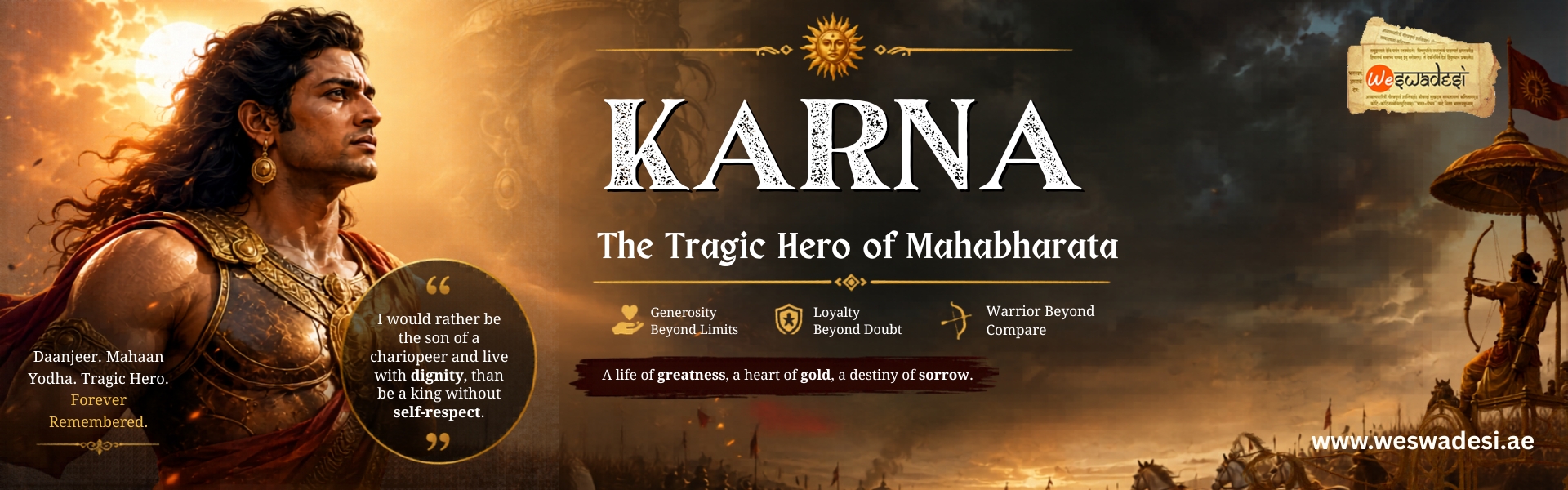
Among all the legendary warriors of the Mahabharata, few characters evoke as much admiration, sympathy, and emotional depth as Karna. Known for his unmatched generosity, incredible warrior skills, painful struggles, and tragic fate, Karna remains one of the most unforgettable personalities in Indian mythology.
Often described as the “tragic hero” of the Mahabharata, Karna’s life was filled with greatness and suffering in equal measure. Though born with divine powers and destined for greatness, he spent most of his life fighting rejection, humiliation, and inner conflict.
Karna’s story is not simply about war—it is about identity, loyalty, destiny, pride, sacrifice, and the painful consequences of standing on the wrong side despite having a noble heart.
Even today, millions connect deeply with Karna because his struggles feel human and relatable:
- Being misunderstood
- Fighting societal judgment
- Wanting respect and acceptance
- Remaining loyal despite emotional pain
- Struggling between morality and obligation
His journey continues to inspire readers of the Bhagavad Gita and Mahabharata across generations.
Who Was Karna?
Karna was one of the greatest warriors in the Mahabharata and the eldest son of Kunti, making him the elder brother of the Pandavas.
However, his true identity remained hidden for most of his life.
Key Facts About Karna
- Parents: Kunti and Surya (Sun God)
- Foster Parents: Adhiratha and Radha
- Title: Angaraja (King of Anga)
- Guru: Parashurama
- Closest Friend: Duryodhana
- Weapon: Vijaya Bow
- Famous Title: Daanveer Karna
- Role: Warrior of the Kaurava side
- Death: 17th day of Kurukshetra War
The Divine Birth of Karna
Karna’s story begins before the birth of the Pandavas.
Kunti received a divine boon from Sage Durvasa:
- She could invoke any god and receive a child from them.
Out of curiosity and innocence, young Kunti invoked Surya, the Sun God.
As a result:
- Karna was born with divine armor (Kavacha)
- Golden earrings (Kundala)
- Extraordinary strength and brilliance
However, because Kunti was unmarried:
- Society would not accept the child
- Fear and shame forced her to abandon him
This heartbreaking moment shaped Karna’s destiny forever.
Karna’s Adoption and Childhood
The infant Karna was found floating in a basket on a river by:
- Adhiratha, a charioteer
- His wife Radha
They lovingly raised him as their own son.
Although Karna possessed extraordinary talent:
- Society constantly mocked him
- He was insulted as a “Suta Putra” (son of a charioteer)
This rejection deeply wounded him emotionally.
Karna’s Identity Crisis
Throughout his life, Karna struggled with:
- Feeling unwanted
- Social discrimination
- Desire for respect
- Need for recognition
This emotional pain became one of the biggest driving forces behind his decisions.
Karna’s Passion for Archery
From childhood, Karna dreamed of becoming:
- The greatest warrior
- Equal to Arjuna
However, because of his perceived low birth:
- Teachers rejected him
- Society denied him opportunities
Yet Karna refused to give up.
Learning from Parashurama
Determined to master warfare, Karna approached:
Parashurama
But Parashurama taught only Brahmins.
So Karna lied about his identity.
Under Parashurama:
- Karna mastered celestial weapons
- Became one of the greatest archers in history
However, fate struck again.
The Curse of Parashurama
One day, while Parashurama rested on Karna’s lap:
- An insect bit Karna deeply
- Karna silently endured the pain
Seeing this extraordinary endurance, Parashurama realized:
- Karna could not be a Brahmin
Feeling betrayed, he cursed Karna:
- He would forget the use of divine weapons when he needed them most
This curse later played a major role in Karna’s death.
Karna and Duryodhana’s Friendship
One of the most defining moments of Karna’s life came when:
- He was publicly humiliated during a martial competition
When Karna challenged Arjuna:
- His birth status was questioned
- He was insulted before everyone
At that moment:
Duryodhana stepped forward.
He:
- Crowned Karna as King of Anga
- Gave him honor and respect
- Accepted him as a friend
For the first time:
- Karna felt valued
This moment created an unbreakable bond between Karna and Duryodhana.
Why Karna Stayed Loyal to Duryodhana
Many people question:
Why did Karna support adharma?
The answer lies in gratitude and loyalty.
Karna believed:
- Duryodhana stood by him when no one else did
- Abandoning him would be betrayal
Even after discovering:
- The Pandavas were his brothers
Karna still chose loyalty to Duryodhana.
This decision became both:
- His greatest virtue
- His greatest tragedy
Karna’s Inner Conflict
Karna was not evil.
In fact:
- He understood righteousness
- Respected noble values
- Admired Krishna and the Pandavas
Yet:
- Emotional loyalty kept him tied to the Kauravas
This inner conflict makes Karna one of the most psychologically complex characters in the Mahabharata.
Karna and Krishna
Before the Kurukshetra War:
Krishna approached Karna privately.
Krishna revealed:
- Karna was Kunti’s eldest son
- He was the rightful eldest Pandava
Krishna offered him:
- Kingship
- Respect
- Acceptance
But Karna refused.
Why Did Karna Refuse Krishna’s Offer?
Because:
- He did not want to betray Duryodhana
- He valued loyalty above power
This decision defines Karna’s tragic greatness.
Karna and Kunti
Kunti later met Karna before the war.
She begged him:
- Not to kill the Pandavas
Karna promised:
- He would spare all Pandavas except Arjuna
This reveals:
- Karna’s compassion
- His respect for his mother despite abandonment
Karna’s Generosity: Daanveer Karna
Karna is remembered as:
- The greatest giver in Indian mythology
His generosity had no limits.
The Kavacha and Kundala Story
Indra, Arjuna’s father, feared Karna’s power.
Disguised as a Brahmin:
- He asked Karna for his divine armor and earrings
Karna knew:
- Giving them away would weaken him
Yet he still donated them.
This act earned him eternal fame as:
Daanveer Karna
Karna in the Kurukshetra War
Karna entered the war with:
- Incredible strength
- Divine weapons
- Unmatched determination
However:
- Fate and curses continued to haunt him
Challenges Faced by Karna
- Curse from Parashurama
- Curse from a Brahmin
- Loss of divine armor
- Emotional conflict
- Isolation
Still, he fought heroically.
Karna vs Arjuna
The battle between Karna and Arjuna is one of the greatest moments in the Mahabharata.
It symbolized:
- Destiny vs effort
- Recognition vs rejection
- Dharma vs loyalty
During the battle:
- Karna’s chariot wheel got stuck
- He forgot weapon mantras due to Parashurama’s curse
At that moment:
Krishna urged Arjuna to attack.
Arjuna killed Karna while he was vulnerable.
Why Karna’s Death Feels Tragic
Karna’s death remains emotionally powerful because:
- He died without full recognition
- He fought for the wrong side despite noble intentions
- He suffered throughout life despite his virtues
His story raises difficult questions:
- Is loyalty always right?
- Can good people make tragic choices?
- Does society create villains through rejection?
Karna’s Relationship with Dharma
Karna understood dharma but struggled to follow it completely.
He:
- Opposed injustice internally
- Yet supported Duryodhana externally
This contradiction defines his tragedy.
Karna’s Biggest Weakness
His biggest weakness was:
- Attachment to loyalty over righteousness
The Mahabharata shows:
Even noble people can suffer if they support adharma knowingly.
Lessons from Karna’s Life
1. Talent Alone Is Not Enough
Karna was immensely gifted but lacked social acceptance.
2. Loyalty Must Have Limits
Blind loyalty can lead to destruction.
3. Society’s Rejection Can Shape Destiny
Discrimination deeply affected Karna’s life choices.
4. Generosity Is True Greatness
Karna’s giving nature made him immortal in history.
5. Anger and Ego Can Cloud Judgment
Emotional wounds influenced many of Karna’s decisions.
Karna in Bhagavad Gita Perspective
The Bhagavad Gita teaches:
- Follow dharma
- Control attachment
- Perform righteous action
Karna represents:
- The pain of emotional attachment
- The conflict between morality and loyalty
Unlike Arjuna:
- Karna never fully detached from emotional pain
His life becomes a powerful contrast to Krishna’s teachings.
Was Karna Greater Than Arjuna?
This debate continues even today.
Why Some Consider Karna Greater
- Faced more hardships
- Had fewer advantages
- Displayed unmatched generosity
- Fought despite repeated misfortune
Why Arjuna Is Considered Superior
- Followed dharma
- Accepted Krishna’s guidance
- Maintained emotional balance
Both warriors symbolize different human struggles.
Karna’s Psychological Depth
Karna is admired because he feels deeply human.
He experienced:
- Rejection
- Insecurity
- Pride
- Loneliness
- Emotional conflict
Modern readers connect with Karna because:
- His pain feels real
- His flaws feel relatable
Karna in Modern Culture
Karna remains one of the most beloved characters in Indian storytelling.
In Television and Films
- Mahabharata serials
- Animated adaptations
- Modern reinterpretations
In Literature
- Books exploring his psychology
- Feminist and philosophical perspectives
In Spiritual Discussions
- Symbol of loyalty and tragedy
- Example of karma and consequences
Relevance of Karna in Modern Life
Karna’s story resonates strongly today because many people:
- Feel underestimated
- Face discrimination
- Struggle for recognition
- Carry emotional wounds
His journey teaches:
- Self-worth should not depend on society
- Loyalty should not override ethics
- Inner healing is essential
Why Karna Still Inspires Millions
Despite standing on the losing side:
- People admire Karna’s humanity
He was:
- Noble yet flawed
- Strong yet emotional
- Generous yet tragic
His life proves:
Greatness and suffering can exist together.
Conclusion
Karna remains one of the greatest tragic heroes in world literature.
He was:
- A warrior of unmatched courage
- A friend of extraordinary loyalty
- A giver beyond comparison
- A man broken by rejection and destiny
Karna’s life teaches us:
- Virtue alone does not guarantee success
- Choices matter more than talent
- Dharma must guide loyalty
- Emotional wounds can shape destiny
His story continues to move hearts because it reflects the struggles of humanity itself.
Karna is not remembered merely for how he died—
He is remembered for how deeply he lived.
FAQs About Karna
1. Who was Karna in the Mahabharata?
Karna was the eldest son of Kunti and Surya, raised by a charioteer family, and one of the greatest warriors in the Mahabharata.
2. Why did Karna support Duryodhana?
Karna remained loyal because Duryodhana gave him respect and honor when society rejected him.
3. Why is Karna called Daanveer?
He was famous for his unmatched generosity and never refused anyone seeking charity.
4. What curse did Karna receive from Parashurama?
Parashurama cursed Karna that he would forget divine weapon mantras during his most critical battle.
5. Was Karna stronger than Arjuna?
Karna was extraordinarily powerful, but Arjuna had Krishna’s guidance and remained aligned with dharma.
