

- Your cart is empty
- Continue Shopping
Karmanye vadhikaraste – (Karma Yoga) – Bhagavad Gita Shlok – Chapter 2, Verse 47

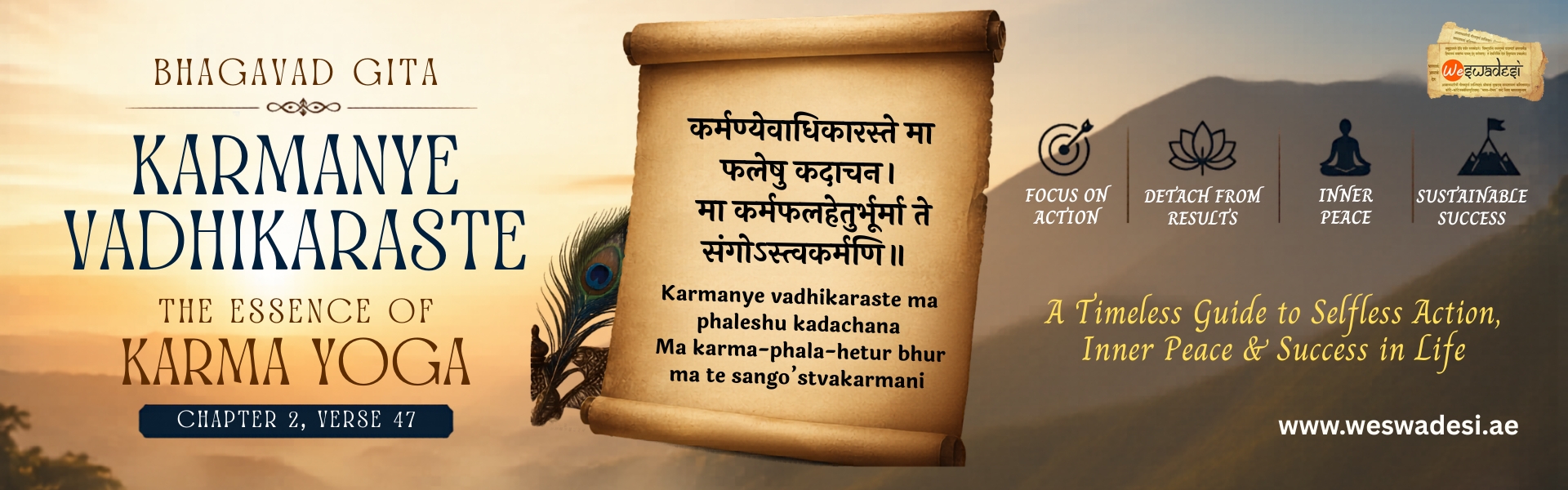
A Complete Guide to Meaning, Significance, and Practical Application
The timeless wisdom of the Bhagavad Gita continues to guide millions of people across the world. Among its most powerful teachings is Chapter 2, Verse 47, popularly known as the essence of Karma Yoga. This verse teaches us how to work, live, and find peace without being burdened by stress, expectations, or fear of failure.
In today’s fast-paced world—where outcomes, results, and success metrics dominate our lives—this shloka offers a refreshing and deeply transformative perspective.
The Shloka
Sanskrit:
कर्मण्येवाधिकारस्ते मा फलेषु कदाचन।
मा कर्मफलहेतुर्भूर्मा ते संगोऽस्त्वकर्मणि॥
Karmanye vadhikaraste ma phaleshu kadachana
Ma karma-phala-hetur bhur ma te sango’stvakarmani
Simple Meaning
You have the right to perform your duties, but you are not entitled to the results of your actions. Do not let the fruits of action be your motive, and never become attached to inaction.
Understanding the Core Philosophy
This verse is not about ignoring results or becoming careless. Instead, it teaches detachment from outcomes while maintaining full dedication to action.
Let’s break it down into four key teachings:
1. Focus on Your Actions (Karma)
The verse begins with a clear message—your control lies only in your actions. You can choose how you work, how much effort you put in, and how sincerely you perform your duties.
2. Let Go of Results (Phala)
While actions are in your control, results are influenced by multiple factors—time, environment, other people, and circumstances. Attachment to results leads to anxiety and disappointment.
3. Don’t Work Only for Rewards
If your only motivation is the outcome (money, success, recognition), your peace becomes dependent on external factors. This creates instability in your emotional well-being.
4. Avoid Inaction
Detachment does not mean avoiding work. The verse clearly warns against laziness or escapism. You must act—consistently and responsibly.
What is Karma Yoga?
Karma Yoga is the path of selfless action. It is the practice of doing your duty without attachment to personal gain.
In simple terms:
- Work with full dedication
- Avoid expectation of reward
- Accept results with balance
Karma Yoga transforms everyday work into a spiritual practice.
Why This Verse is So Important Today
Modern life is heavily result-oriented:
- Job performance is measured by targets
- Businesses are judged by profits
- Social media revolves around likes and followers
This constant focus on outcomes creates:
- Stress
- Anxiety
- Fear of failure
- Burnout
This shloka provides a powerful solution:
Detach from results and focus on effort.
Practical Application in Daily Life
1. In Career and Business
Instead of worrying about promotions or profits:
- Focus on improving your skills
- Deliver your best work
- Build consistency
Results will follow naturally over time.
2. In Relationships
Don’t expect constant appreciation or validation:
- Give love and care selflessly
- Avoid keeping score
This creates healthier and stronger relationships.
3. In Studies and Learning
Students often stress about marks and rankings:
- Focus on understanding concepts
- Build discipline in study habits
This approach improves both performance and confidence.
4. In Spiritual Growth
Karma Yoga helps reduce ego and attachment:
- Actions become offerings
- Mind becomes calmer
- Inner peace increases
Psychological Benefits of Practicing This Verse
Applying this teaching can significantly improve mental well-being:
Reduced Stress
When you stop obsessing over outcomes, your mind becomes lighter.
Increased Focus
Without distraction from results, you can fully concentrate on the task.
Emotional Stability
Success and failure no longer control your mood.
Greater Satisfaction
You begin to enjoy the process rather than chasing results.
Common Misunderstandings
Myth 1: “Results Don’t Matter”
Reality: Results matter, but attachment to them causes suffering.
Myth 2: “This Promotes Laziness”
Reality: The verse clearly discourages inaction. It promotes dedicated effort, not avoidance.
Myth 3: “It’s Only Spiritual, Not Practical”
Reality: This principle is widely used in:
- Leadership philosophy
- Sports psychology
- Productivity systems
Deep Spiritual Insight
At a deeper level, this verse teaches surrender.
When you perform actions without attachment:
- Ego reduces
- Desire weakens
- Inner peace increases
It shifts your identity from “I am the doer” to “I am an instrument.”
This mindset is considered a key step toward spiritual liberation (moksha).
Real-Life Example
Imagine two people working on the same project:
Person A:
- Constantly worried about results
- Fears failure
- Gets stressed easily
Person B:
- Focuses on doing the best work
- Accepts outcomes calmly
- Stays peaceful regardless of result
Over time, Person B not only performs better but also lives a happier life.
That is the power of Karma Yoga.
How to Practice This Teaching Daily
Start small and build consistency:
Step 1: Set Clear Intentions
Before starting any task, remind yourself:
“I will give my best without worrying about the result.”
Step 2: Focus Fully on the Present
Avoid distractions and overthinking about the future.
Step 3: Accept Outcomes Gracefully
Whether success or failure—accept it without emotional extremes.
Step 4: Reflect and Improve
Learn from every result, but don’t get attached to it.
Relevance for Entrepreneurs and Professionals
For business owners and professionals, this verse is extremely powerful:
- Helps handle uncertainty in business
- Reduces pressure from financial ups and downs
- Encourages long-term thinking
- Builds resilience and patience
Instead of chasing quick results, you focus on consistent value creation.
Why This Verse is Timeless
Even after thousands of years, this teaching remains relevant because:
- Human nature hasn’t changed
- Desire and attachment still cause suffering
- The need for peace and balance is universal
This verse provides a simple yet profound life formula:
Do your best, and let go of the rest.
Conclusion
“कर्मण्येवाधिकारस्ते” is not just a verse—it is a life-changing principle.
It teaches us:
- To act with sincerity
- To detach from results
- To stay balanced in all situations
By practicing this teaching, you can achieve:
- Better performance
- Inner peace
- Emotional strength
- Spiritual growth
In a world driven by outcomes, this ancient wisdom reminds us of a powerful truth:
Peace lies not in results, but in the way we act.FAQs
1. What is the main message of “Karmanye Vadhikaraste”?
The main message is to focus on your actions and not be attached to the results. Perform your duty sincerely and accept outcomes with balance.
2. Does this verse mean we should ignore results?
No, it does not mean ignoring results. It teaches not to be emotionally dependent on results, while still working responsibly.
3. How can I apply this in my daily work life?
Focus on giving your best effort, avoid overthinking about outcomes, and accept results calmly. This reduces stress and improves productivity.
4. Is Karma Yoga only for spiritual people?
No, Karma Yoga is for everyone—students, professionals, entrepreneurs, and homemakers. It is a practical approach to living a balanced life.
5. How does this teaching reduce stress and anxiety
Stress comes from worrying about outcomes. When you detach from results and focus on effort, your mind becomes calm and more focused.
