

- Your cart is empty
- Continue Shopping
Arjuna: The Ideal Warrior of Bhagavad Gita & Symbol of Dharma

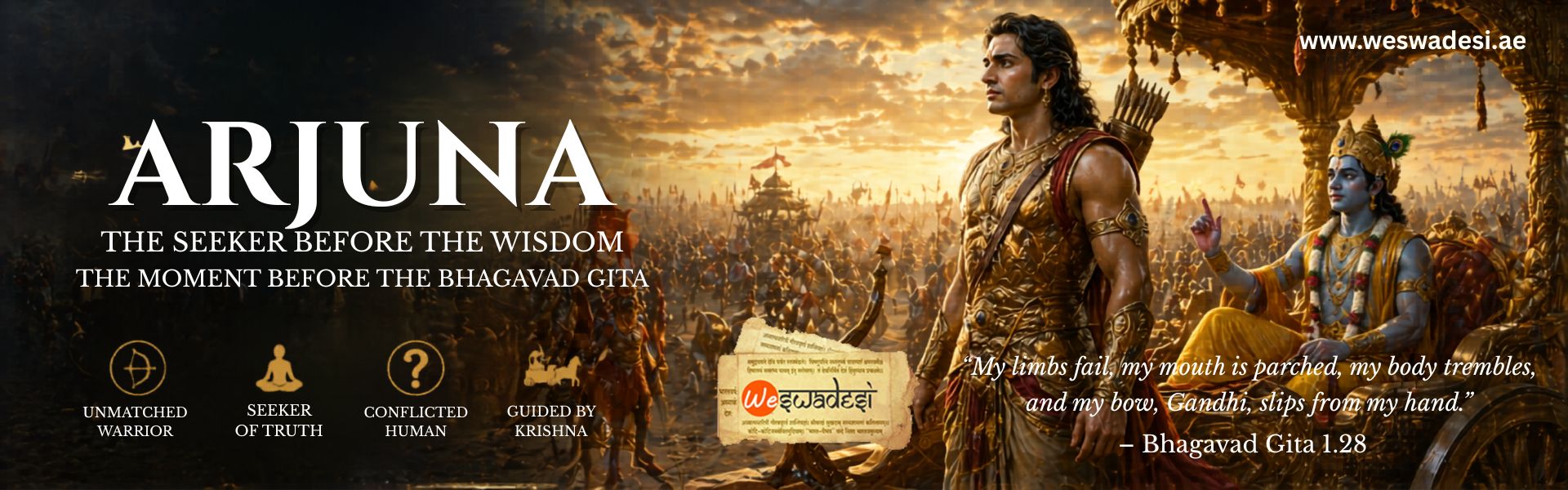
Introduction
Among the most compelling figures in the Bhagavad Gita, Arjuna stands as the perfect representation of human struggle, courage, and spiritual awakening. A legendary warrior from the Mahabharata, Arjuna is not just known for his unmatched archery skills but also for his deep moral conflict on the battlefield of Kurukshetra.
His moment of doubt and confusion becomes the foundation for one of the greatest philosophical teachings ever delivered—by his charioteer and divine guide, Krishna.
Arjuna’s journey from hesitation to enlightenment makes him one of the most relatable and inspiring characters in Hindu philosophy.
Key Facts About Arjuna
- Parents: Kunti and Indra
- Siblings: Yudhishthira, Bhima, Nakula, Sahadeva
- Wives: Draupadi and Subhadra
- Son: Abhimanyu
- Guru: Dronacharya
- Weapon: Gandiva bow
- Epic: Mahabharata
Divine Birth and Early Life
Arjuna’s birth was no ordinary event. His mother Kunti invoked a divine boon that allowed her to call upon the gods. Through this blessing, Indra—the king of gods—granted her a son endowed with extraordinary strength, courage, and skill.
From a young age, Arjuna showed exceptional talent in archery. Under the guidance of Guru Drona, he became the most skilled archer among all the princes.
Training Under Drona
Arjuna’s dedication and discipline set him apart:
- Practiced relentlessly, even in darkness
- Maintained intense focus and concentration
- Became Drona’s favorite student
One famous story highlights his focus—while others saw a bird, Arjuna saw only its eye. This symbolizes single-minded concentration, a key lesson in both warfare and spirituality.
Arjuna in the Mahabharata
In the grand narrative of the Mahabharata, Arjuna plays a central role in the conflict between the Pandavas and Kauravas.
He is:
- A protector of dharma
- A fearless warrior
- A loyal brother
However, his greatest moment is not his victories—but his moment of doubt.
The Turning Point: Kurukshetra War
On the battlefield of Kurukshetra, Arjuna faces a devastating reality—he must fight against his own relatives, teachers, and loved ones.
Overwhelmed with grief and confusion, he drops his bow Gandiva and refuses to fight.
This moment is deeply symbolic:
- Conflict between emotion and duty
- Struggle between attachment and righteousness
- Human weakness in the face of responsibility
It is here that Krishna delivers the teachings of the Bhagavad Gita.
Arjuna and the Bhagavad Gita
The Bhagavad Gita is essentially a dialogue between Arjuna and Krishna. Arjuna represents humanity, while Krishna represents divine wisdom.
Arjuna’s Questions
Arjuna asks fundamental questions:
- What is right and wrong?
- Should I fight or withdraw?
- What is my duty?
- What is the purpose of life?
These questions make him relatable to every individual facing difficult decisions.
Krishna’s Teachings to Arjuna
Through Krishna’s guidance, Arjuna learns the core principles of life:
1. Dharma (Duty)
Every individual must perform their duty without fear or attachment.
2. Karma Yoga
Act without expecting results. Focus on effort, not outcome.
3. Bhakti Yoga
Surrender to the divine with love and devotion.
4. Jnana Yoga
Understand the eternal nature of the soul.
Krishna reminds Arjuna:
- The soul never dies
- Death is only a transition
- Righteous action is essential
This transforms Arjuna from a confused warrior into a determined one.
Arjuna’s Transformation
After receiving divine knowledge, Arjuna regains clarity and strength.
He:
- Picks up his Gandiva bow
- Accepts his duty
- Fights with righteousness
This transformation symbolizes spiritual awakening—moving from confusion to clarity, from fear to courage.
Character and Symbolism of Arjuna
Arjuna is more than a warrior—he is a symbol of the human condition.
Key Qualities of Arjuna
1. Courage
Despite fear, he chooses to act.
2. Discipline
Years of training made him exceptional.
3. Humility
Even as a great warrior, he seeks guidance.
4. Moral Awareness
He questions his actions before taking them.
5. Devotion
His trust in Krishna leads him to enlightenment.
Life Lessons from Arjuna
Arjuna’s story offers timeless lessons:
1. It’s Okay to Feel Confused
Even the greatest warriors face doubt.
2. Seek Guidance
Wisdom from the right source can change your life.
3. Focus on Duty
Do what is right, not what is easy.
4. Control Emotions
Balance feelings with responsibility.
5. Trust the Process
Results are not always in your control.
Arjuna as the Ideal Warrior
Arjuna is often described as the “ideal warrior” because he balances:
- Strength with compassion
- Skill with humility
- Power with wisdom
Unlike many warriors driven by ego, Arjuna fights for justice and righteousness.
Arjuna’s Relationships
With Krishna
His bond with Krishna is the foundation of the Bhagavad Gita. Krishna is not just his charioteer but his spiritual guide.
With Draupadi
Arjuna shares a unique relationship with Draupadi, symbolizing duty and respect.
With Abhimanyu
As a father, Arjuna’s legacy continues through his brave son Abhimanyu.
Cultural and Spiritual Impact
Arjuna’s influence extends far beyond scriptures.
In Religion
- Revered in temples and spiritual teachings
- Central to Bhagavad Gita discourse
In Arts
- Depicted in classical dances
- Featured in paintings and sculptures
In Literature & Media
- Retold in books, TV shows, and films
- Symbol of heroism and morality
Relevance of Arjuna in Modern Life
In today’s fast-paced and stressful world, Arjuna’s journey is highly relevant.
We all face:
- Career dilemmas
- Emotional conflicts
- Ethical decisions
Arjuna teaches us:
- Stay calm in difficult situations
- Make decisions based on values
- Seek clarity before action
Arjuna for Devotees in UAEFor devotees living in the UAE, Arjuna’s story is a source of strength and inspiration.
You can:
- Read the Bhagavad Gita daily
- Reflect on Arjuna’s decisions
- Practice karma yoga in daily life
Platforms like weswadesi.ae help you stay connected with spiritual roots through:
- Bhagavad Gita books
- पूजा items
- Idols and devotional products
Conclusion
Arjuna’s journey in the Bhagavad Gita is not just a story—it is a guide for life. His transformation from doubt to determination teaches us how to face challenges with courage and clarity.
He reminds us that:
- Confusion is temporary
- Wisdom is always available
- Duty must be fulfilled
Through Arjuna, we learn that true strength lies not just in power—but in understanding, balance, and devotion.
FAQs About Arjuna
1. Who is Arjuna in the Bhagavad Gita?
Arjuna is a Pandava prince and warrior who receives spiritual guidance from Krishna on the battlefield of Kurukshetra.
2. Why did Arjuna refuse to fight initially?
He was emotionally overwhelmed at the thought of fighting his own family, teachers, and loved ones.
3. What did Krishna teach Arjuna?
Krishna taught him about duty (dharma), selfless action (karma yoga), devotion (bhakti), and the eternal soul.
4. What does Arjuna symbolize?
Arjuna represents the human mind—confused, emotional, yet capable of wisdom and transformation.
5. Why is Arjuna important today?
His story helps people deal with modern challenges like stress, decision-making, and ethical dilemmas.
