
- Your cart is empty
- Continue Shopping
The Soul is Eternal, Unborn, and Indestructible Bhagavad Gita Chapter 2, Verse 20

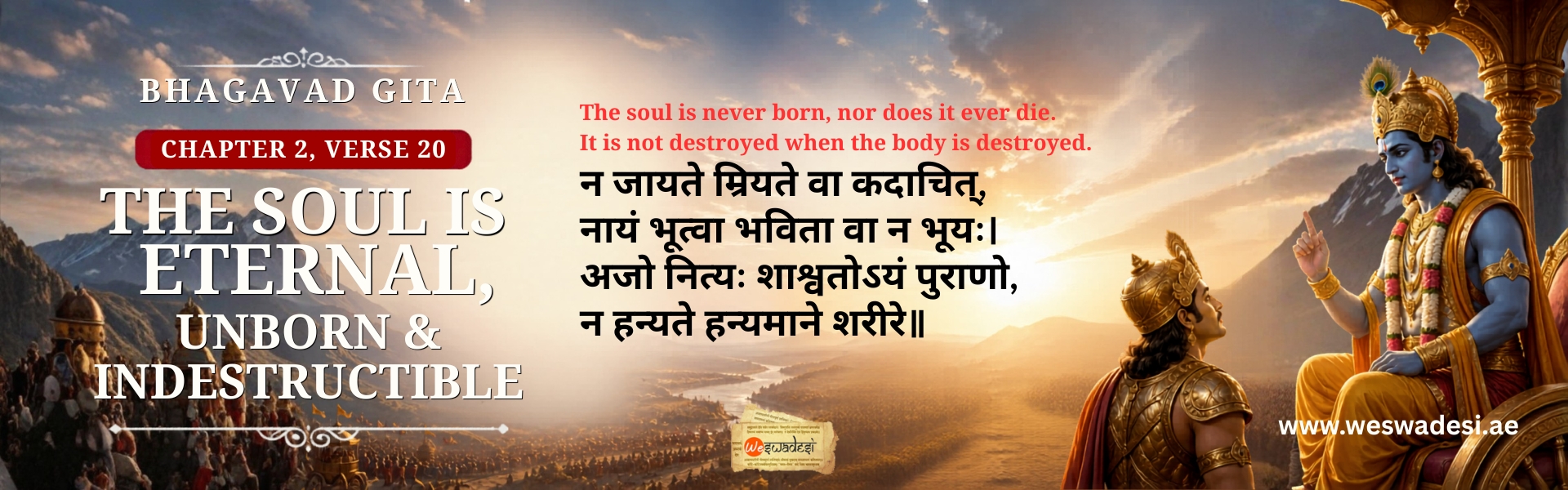
The wisdom of the Bhagavad Gita continues to illuminate human life with timeless truths. Among its most profound teachings is Chapter 2, Verse 20—a verse that directly addresses one of humanity’s deepest fears: death.
This verse reveals the eternal nature of the soul (Ātman) and helps us understand that what we truly are goes far beyond the physical body. Let’s explore this verse in depth and understand its spiritual, philosophical, and practical significance.
The Verse
Sanskrit:
न जायते म्रियते वा कदाचित्
नायं भूत्वा भविता वा न भूयः।
अजो नित्यः शाश्वतोऽयं पुराणो
न हन्यते हन्यमाने शरीरे॥
Transliteration
Na jāyate mriyate vā kadāchit
Nāyaṁ bhūtvā bhavitā vā na bhūyaḥ
Ajo nityaḥ śāśvato’yaṁ purāṇo
Na hanyate hanyamāne śarīre
English Translation
“The soul is never born, nor does it ever die. It does not come into being, nor will it cease to be. It is unborn, eternal, everlasting, and ancient. It is not destroyed when the body is destroyed.”
Context of the Verse
This verse appears in Chapter 2 of the Bhagavad Gita, where Lord Krishna begins imparting spiritual wisdom to Arjuna, who is overwhelmed by grief and confusion on the battlefield of Kurukshetra.
Arjuna is distressed at the thought of killing his relatives, teachers, and loved ones. In response, Krishna introduces the concept of the eternal soul to help Arjuna rise above emotional weakness and understand the deeper reality of life.
This teaching forms the foundation of Vedantic philosophy and is central to understanding life, death, and the true self.
Word-by-Word Meaning
- Na jāyate – Never born
- Mriyate vā – Nor does it die
- Kadāchit – At any time
- Na ayam bhūtvā – Having once existed
- Bhavitā vā na bhūyaḥ – Never ceases to exist
- Ajaḥ – Unborn
- Nityaḥ – Eternal
- Śāśvataḥ – Permanent
- Purāṇaḥ – Ancient
- Na hanyate – Not destroyed
- Hanyamāne śarīre – When the body is destroyed
Deep Meaning of the Verse
1. The Soul is Never Born
Unlike the physical body, which takes birth, the soul does not come into existence at a specific point in time. It has always existed.
This challenges the common belief that life begins at birth. According to this verse, what we call “birth” is simply the soul entering a physical body.
2. The Soul Never Dies
Death is often seen as the end. However, Krishna clarifies that death applies only to the body—not the soul.
When the body dies, the soul continues its journey. This idea removes the fear of absolute annihilation and introduces the concept of continuity.
3. The Soul is Eternal (Nitya)
The soul exists beyond time. It is not affected by past, present, or future. While the body ages, the soul remains unchanged.
This eternal nature is what makes the soul divine and indestructible.
4. The Soul is Unchanging (Śāśvata)
Everything in the material world changes—our bodies, emotions, relationships, and circumstances. But the soul remains constant.
This stability is the foundation of true inner peace.
5. The Soul is Ancient (Purāṇa)
The soul is described as “ancient,” meaning it has existed since time immemorial. It is not something newly created.
This emphasizes the timeless nature of our true identity.
6. The Soul Cannot Be Destroyed
Even when the body is destroyed, the soul remains unaffected. Just as we change clothes, the soul changes bodies.
This idea is further explained in Verse 2.22, where Krishna compares the body to garments.
Philosophical Significance
1. Understanding True Identity
Most people identify themselves with their body, name, profession, or social status. But this verse teaches that our true identity is the soul.
When we shift our identity from body to soul, our perspective on life changes completely.
2. Freedom from Fear of Death
Fear of death is one of the strongest human fears. This verse removes that fear by explaining that death is not the end.
It is simply a transition.
3. Foundation of Karma and Rebirth
If the soul is eternal, it must continue its journey after death. This forms the basis of karma and reincarnation.
Our actions in this life influence our future experiences.
4. Detachment from Material World
Understanding that the body is temporary helps us detach from material attachments.
This does not mean abandoning life, but rather living with awareness and balance.
Scientific and Spiritual Perspective
While modern science focuses on the physical body, spirituality explores consciousness.
Some modern theories in quantum physics and consciousness studies hint at the idea that consciousness may not be limited to the brain.
Though not identical, these ideas resonate with the Gita’s teaching that the soul is beyond physical destruction.
Practical Application in Daily Life
1. Handling Loss and Grief
When we lose a loved one, the pain is real. However, understanding that the soul continues to exist can provide comfort.
It shifts our perspective from loss to transition.
2. Reducing Anxiety
Many anxieties are rooted in fear—fear of loss, failure, or death. Knowing that your true self is eternal reduces these fears.
3. Living with Purpose
If the soul is eternal, life is not random. It has a purpose.
This understanding encourages us to live meaningfully and ethically.
4. Developing Inner Strength
Arjuna was weak and confused. This knowledge made him strong and decisive.
Similarly, understanding this verse can give us clarity in difficult situations.
5. Practicing Detachment
Detachment does not mean indifference. It means staying balanced in success and failure.
This is the essence of spiritual maturity.
Connection with Other Gita Teachings
This verse is closely related to several other teachings in the Gita:
- Chapter 2, Verse 13 – The soul passes through childhood, youth, and old age
- Chapter 2, Verse 22 – Changing bodies like clothes
- Chapter 2, Verse 47 – Focus on action, not results
Together, these verses build a complete understanding of life and duty.
Modern Relevance
In today’s fast-paced world, people are constantly chasing temporary achievements.
This verse reminds us to look beyond material success and focus on inner growth.
It encourages:
- Mindfulness
- Emotional stability
- Spiritual awareness
Key Takeaways
- You are not your body—you are the soul
- The soul is eternal and indestructible
- Death is not the end, but a transition
- Understanding this truth removes fear and brings peace
- Living with this awareness leads to a meaningful life
Frequently Asked Questions (FAQs)
1. What is the main message of Bhagavad Gita 2.20?
The verse teaches that the soul is eternal, unborn, and indestructible, and it does not die when the body dies.
2. Does this verse prove life after death?
Yes, it strongly supports the concept of life after death by explaining that the soul continues to exist.
3. What does “unborn” mean in this context?
It means the soul has no beginning—it has always existed.
4. How is the soul different from the body?
The body is temporary and perishable, while the soul is eternal and unchanging.
5. Why is this verse important?
It removes fear of death and helps us understand our true identity.
6. How can this verse help in daily life?
It helps reduce anxiety, manage grief, and develop inner strength.
7. What is the meaning of “Na hanyate hanyamāne śarīre”?
It means the soul is not destroyed when the body is destroyed.
8. Does this verse relate to reincarnation?
Yes, it supports the idea that the soul continues its journey through different bodies.
9. Can science explain this concept?
While science does not fully explain the soul, some theories about consciousness align with this idea.
10. How can I apply this teaching practically?
By practicing detachment, focusing on purpose, and understanding your true self beyond the body.
Conclusion
Bhagavad Gita Chapter 2, Verse 20 is a powerful reminder of who we truly are. In a world filled with change and uncertainty, this verse offers something timeless—the truth of our eternal nature.
When we understand that we are not just physical beings but eternal souls, our fears begin to dissolve, our purpose becomes clearer, and our life gains a deeper meaning.
This wisdom is not just philosophical—it is practical, transformative, and deeply empowering.
