

- Your cart is empty
- Continue Shopping
Balaji Rangachari @ GMBF -Adversity to Advantage: How UAE Businesses Are Turning Uncertainty Into Opportunity

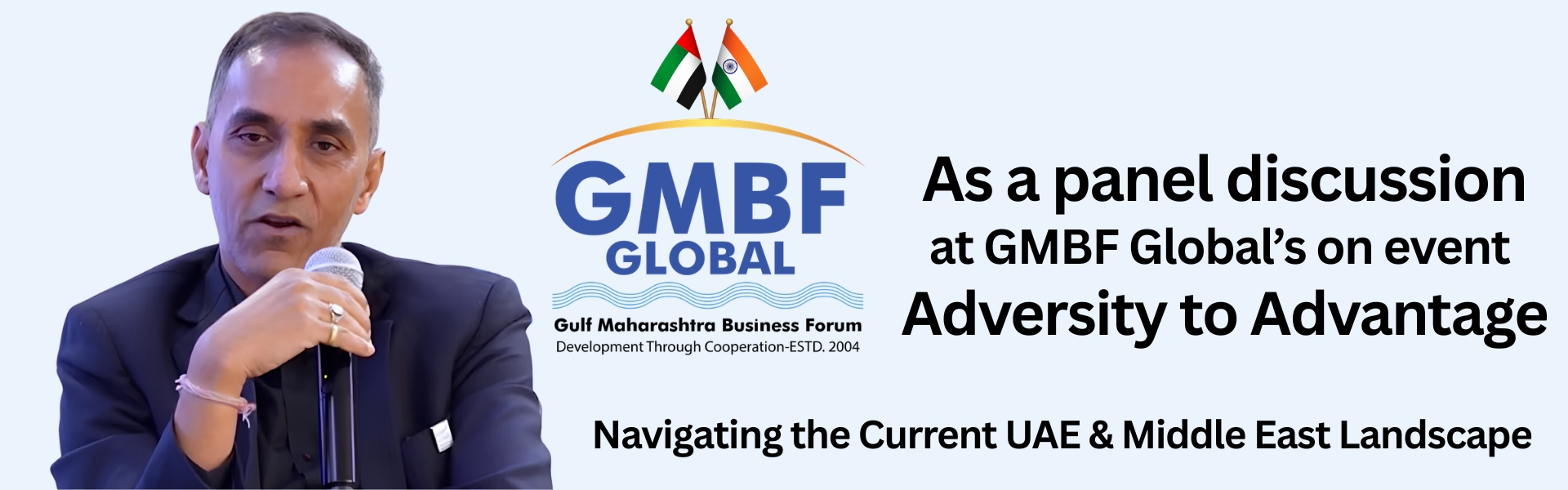
The business landscape across the UAE and the Middle East is evolving faster than ever before. Economic shifts, geopolitical uncertainty, rising operational costs, changing customer behavior, and rapid digital transformation are forcing organizations to rethink how they operate.
Yet, amid these challenges, one powerful idea is becoming increasingly relevant:
Adversity does not define businesses. Leadership response does.
At a recent panel discussion hosted by GMBF Global in Dubai, industry leaders came together to discuss one of the most important business topics today:
“Adversity to Advantage – Navigating the Current UAE & Middle East Landscape”
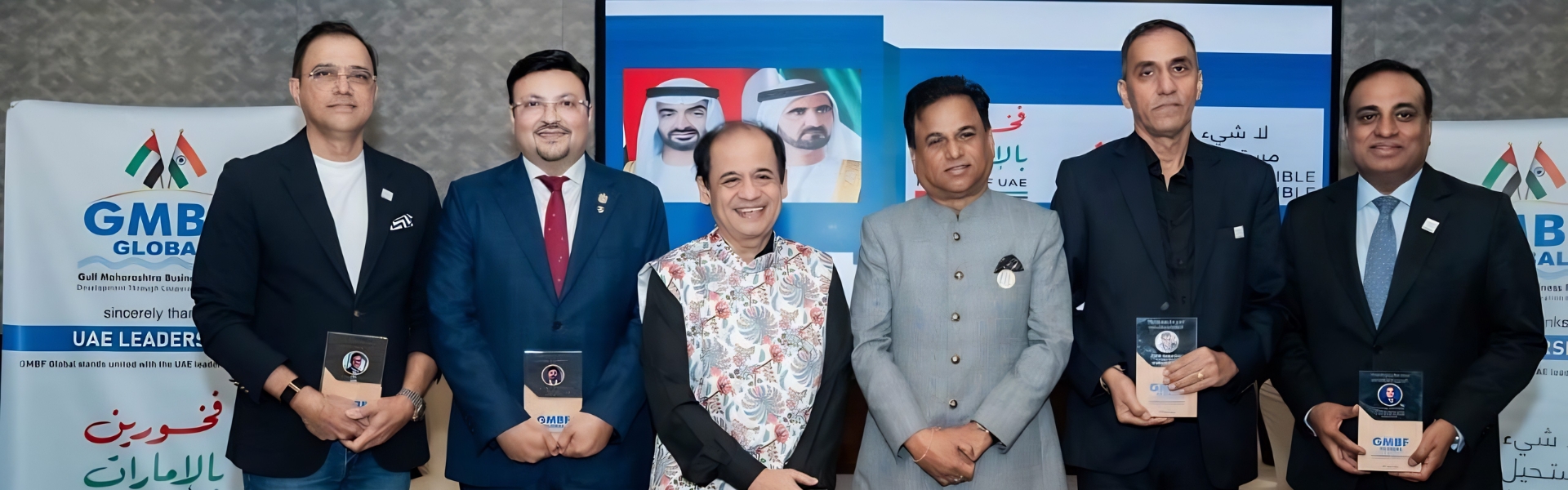
The discussion featured experienced business leaders including Balaji Rangachari, James Mathew, and Shresht Sharma, with moderation by Chirantan Joshi.
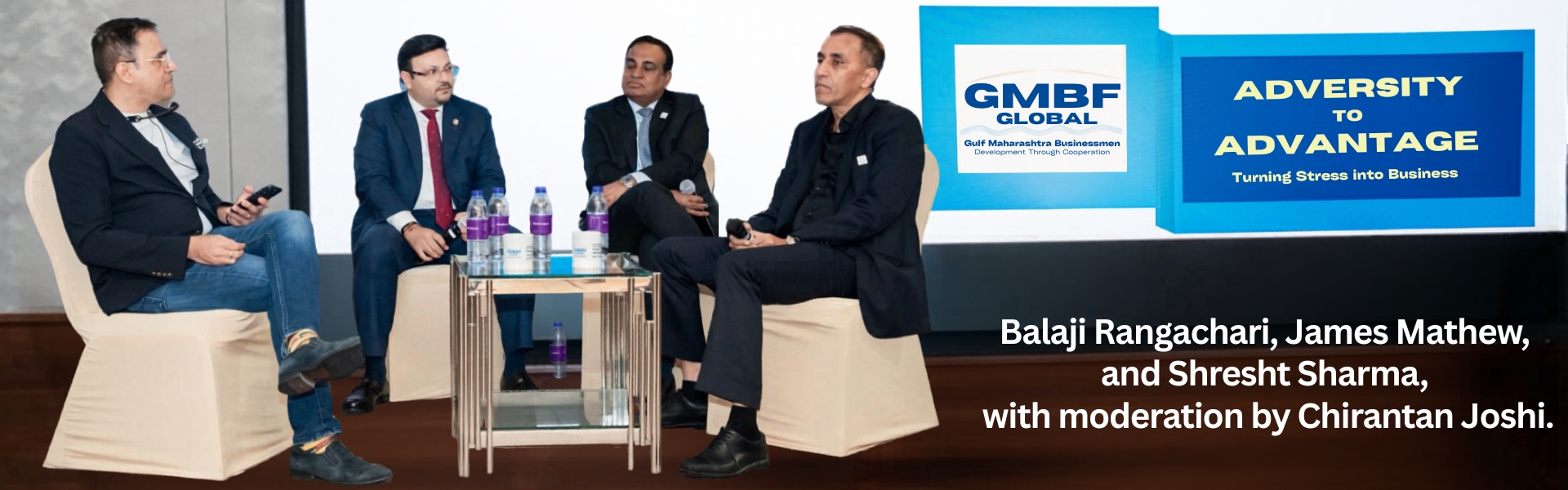
What made the conversation meaningful was its practical nature. Instead of discussing theoretical business ideas, the panel focused on real-world issues affecting SMEs, entrepreneurs, and business leaders across the UAE today.
Topics included:
- Cash flow pressure
- Operational uncertainty
- Leadership during crises
- Employee retention and reskilling
- AI and automation challenges
- Disaster preparedness
- Communication strategies
- Market adaptability
- Building resilient organizations
The biggest takeaway?
The UAE market is still filled with opportunities — but businesses now need stronger alignment, faster adaptability, and smarter leadership to succeed.
Why “Adversity to Advantage” Matters More Than Ever
Across the Middle East, businesses are facing an environment where change is constant.
Organizations are dealing with:
- Global economic fluctuations
- Inflationary pressure
- Supply chain disruptions
- Customer spending shifts
- AI-driven transformation
- Increased competition
- Geopolitical uncertainty
For SMEs especially, these pressures can feel overwhelming.
However, adversity often creates the perfect environment for innovation, clarity, and transformation.
Many of the world’s strongest companies were built during difficult times because adversity forces organizations to:
- Improve efficiency
- Refocus priorities
- Build stronger teams
- Develop better systems
- Innovate faster
- Strengthen customer trust
The UAE business ecosystem has consistently shown resilience through periods of uncertainty — from the global financial crisis to COVID-19 and beyond.
Today, businesses are entering another defining phase.
The question is no longer:
“How do we survive uncertainty?”
The real question is:
“How do we use uncertainty as a competitive advantage?”
The UAE Market Is Not Difficult — It Is More Selective
One of the strongest insights shared during the discussion was this:
“The UAE market isn’t short of opportunities — it’s demanding better alignment and faster adaptability.”
This statement perfectly reflects the current market reality.
Businesses that continue using outdated systems, slow decision-making, and rigid structures are struggling to maintain momentum.
Meanwhile, companies that are:
- Agile
- Customer-focused
- Technology-enabled
- Strategy-driven
- Trust-led
are continuing to grow.
The UAE economy remains one of the most opportunity-rich markets globally.
However, the market today rewards:
- Speed
- Clarity
- Value creation
- Innovation
- Operational discipline
Consumers and businesses alike are becoming more selective about where they spend money and who they trust.
This shift is not necessarily negative.
In fact, it creates opportunities for businesses that are willing to evolve.
Leadership During Uncertainty: Strategy Over Panic
One of the most important themes discussed was leadership behavior during difficult times.
When uncertainty increases, many business leaders naturally shift into operational mode.
They become consumed by:
- Daily problems
- Immediate cash flow concerns
- Customer complaints
- Team pressure
- Operational firefighting
While operational awareness is important, the panel emphasized that leaders must remain strategically focused during crises.
Why Strategic Leadership Matters
During uncertain periods, employees look toward leadership for:
- Direction
- Stability
- Clarity
- Confidence
- Decision-making
If leaders themselves become reactive and emotionally driven, uncertainty spreads throughout the organization.
Strong CEOs and business leaders maintain focus on:
1. Long-Term Direction
Even during temporary disruptions, leaders must keep the company aligned with long-term objectives.
2. Clear Communication
Teams perform better when they understand priorities and expectations.
3. Smart Decision-Making
Not every challenge requires immediate reaction. Strategic patience is often more valuable than panic.
4. Organizational Stability
Employees and customers trust organizations that remain composed during pressure.
The businesses that succeed during uncertainty are not always the biggest.
They are often the businesses with leaders who stay calm, focused, and adaptable.
Continuous Communication Is the Currency in a Crisis
One quote from the discussion stood out powerfully:
“Continuous communication is the currency in a crisis.”
This insight captures one of the most overlooked elements of business resilience.
During uncertainty, people naturally create assumptions when information is missing.
This happens internally and externally.
Inside Organizations
Employees begin to wonder:
- Is the company stable?
- Will jobs be affected?
- Are customers leaving?
- What changes are coming?
Without communication, anxiety increases.
Outside Organizations
Customers and partners may question:
- Is the company operational?
- Are services affected?
- Can they trust the business long-term?
This is why communication becomes critical.
What Effective Crisis Communication Looks Like
Businesses that communicate effectively during challenging periods focus on:
Transparency
Honest communication builds credibility and trust.
Frequency
Silence creates uncertainty. Consistent updates create stability.
Clarity
Confusing communication increases stress.
Leadership Visibility
Employees trust leaders who remain present and accessible.
Empathy
Communication should recognize the emotional realities teams are facing.
Organizations that master communication often recover faster because trust remains intact.
Why Knee-Jerk Decisions Hurt Businesses
One of the major concerns discussed during the panel was the growing tendency of businesses to make rushed decisions under pressure.
Examples include:
- Sudden layoffs
- Aggressive cost-cutting
- Poor hiring decisions
- Unplanned restructuring
- Reactive investments
- Eliminating long-term growth initiatives
While short-term decisions may temporarily reduce pressure, they often create larger long-term problems.
The Hidden Cost of Reactive Leadership
Reactive decisions can damage:
- Team morale
- Customer trust
- Brand reputation
- Organizational capability
- Innovation potential
Businesses must learn to distinguish between:
- Necessary strategic action
and - Emotion-driven reaction
The strongest organizations are disciplined under pressure.
Reskilling and Redeployment: The Smarter Workforce Strategy
Another major discussion point centered around workforce management.
During economic pressure, employee termination is often viewed as the fastest solution.
However, this approach can weaken organizations over time.
The panel strongly emphasized:
People Are Long-Term Assets
Organizations that invest in their employees build stronger internal capability.
Instead of immediate workforce reduction, businesses should consider:
- Reskilling employees
- Cross-functional training
- Redeployment into new roles
- Technology training
- Leadership development
This creates long-term sustainability.
Why Reskilling Matters in the AI Era
AI and automation are transforming industries across the UAE and globally.
However, technology alone does not create efficiency.
One important insight discussed was:
“Technology without capability creates dependency and underutilization.”
Many companies invest heavily in tools but fail to train employees effectively.
As a result:
- Systems remain underused
- Productivity gains are limited
- Employees resist adoption
- ROI decreases
The businesses that benefit most from AI are not necessarily those spending the most money.
They are the organizations investing equally in:
- Technology
- Training
- Process alignment
- Human capability
AI and Automation: Opportunity or Risk?
AI adoption is accelerating across industries including:
- Retail
- HR
- Healthcare
- Finance
- Logistics
- Customer service
- Marketing
- Manufacturing
In the UAE especially, digital transformation continues to be a national priority.
However, many businesses are still navigating important questions:
- Which AI tools should we adopt?
- How do we train teams?
- How do we measure ROI?
- Will automation replace jobs?
- How do we remain competitive?
The panel discussion highlighted an important reality:
AI Should Enhance Human Capability — Not Replace Human Thinking
Businesses that combine:
- Human intelligence
- Strategic leadership
- Technology adoption
- Continuous learning
will outperform organizations that rely only on automation.
The future belongs to businesses that balance efficiency with human-centered leadership.
Have Businesses Truly Learned From COVID?
One powerful question raised during the discussion was:
“We have already experienced a disruption like COVID. But have we truly built structured disaster management into our organizations?”
This question deserves serious reflection.
Many businesses survived COVID by reacting quickly.
But survival and preparedness are not the same thing.
What True Business Preparedness Looks Like
Organizations today need structured frameworks for:
Risk Management
Identifying operational vulnerabilities before crises occur.
Financial Planning
Maintaining cash reserves and flexible financial structures.
Remote Operations
Ensuring operational continuity during disruptions.
Digital Infrastructure
Technology systems that support scalability and resilience.
Leadership Succession
Prepared leadership structures during emergencies.
Communication Plans
Clear crisis communication protocols.
Preparedness is no longer optional.
It is now a core leadership responsibility.

SMEs in the UAE: Challenges and Opportunities
Small and medium-sized businesses remain the backbone of the UAE economy.
However, SMEs are currently facing several challenges:
- Rising operational expenses
- Cash flow management pressure
- Hiring difficulties
- Market competition
- Slower customer decision-making
- Technology adaptation
Despite this, the UAE continues to provide one of the strongest business ecosystems globally.
Why the UAE Remains a Global Business Hub
The UAE continues to attract businesses because of:
- Strong infrastructure
- Business-friendly policies
- Global connectivity
- Innovation focus
- Digital transformation initiatives
- Strategic location
- Entrepreneurial ecosystem
Businesses that align with market evolution still have enormous growth potential.
Adaptability Is the New Competitive Advantage
One of the clearest conclusions from the discussion was this:
“It’s no longer about who is the biggest. It’s about who adapts the fastest and thinks the smartest.”
This reflects a major shift in modern business dynamics.
In the past, scale alone created advantage.
Today, adaptability matters more.
Characteristics of Highly Adaptable Businesses
Successful organizations today demonstrate:
Fast Decision-Making
They move quickly without losing strategic clarity.
Customer-Centric Thinking
They adapt according to customer behavior.
Technology Integration
They embrace digital transformation intelligently.
Flexible Teams
Employees are multi-skilled and agile.
Learning Culture
Continuous improvement becomes part of the organization.
Data-Driven Leadership
Decisions are based on insight, not assumptions.
Adaptability allows businesses to remain competitive even during uncertainty.
Why Trust-Led Businesses Win in Difficult Times
Trust was another important theme that emerged during the discussion.
In uncertain environments, customers become more selective.
People choose businesses they trust.
This applies to:
- Customers
- Employees
- Investors
- Partners
Trust-led organizations consistently outperform because they build long-term credibility.
How Businesses Build Trust During Crisis
Consistency
Reliable delivery creates confidence.
Honest Communication
Transparency strengthens relationships.
Ethical Leadership
Integrity matters more during uncertainty.
Employee Care
People-first cultures build loyalty.
Customer Support
Businesses that support customers during difficult times are remembered long-term.
Trust becomes a competitive advantage that cannot easily be copied.
The Importance of Internal Alignment
Periods of uncertainty often expose internal organizational weaknesses.
Many businesses discover:
- Communication gaps
- Leadership misalignment
- Department silos
- Operational inefficiencies
- Weak processes
However, these periods also create opportunity.
Organizations can use challenging times to:
- Rebuild culture
- Improve systems
- Align teams
- Clarify goals
- Strengthen leadership
The businesses that emerge stronger are often those willing to slow down, reflect, and improve internally.
The Role of Emotional Intelligence in Leadership
Modern leadership is no longer based only on operational expertise.
Today’s leaders must also demonstrate emotional intelligence.
Employees want leaders who can:
- Listen
- Communicate clearly
- Show empathy
- Stay calm under pressure
- Build trust
- Inspire confidence
Especially during uncertain periods, emotional intelligence becomes a critical leadership skill.
Organizations led with empathy often retain stronger employee loyalty and engagement.
Why Conversations Like These Matter
Industry discussions like the GMBF Global panel create value because they bring together:
- Different perspectives
- Real experiences
- Practical solutions
- Strategic insights
In today’s fast-changing business environment, clarity itself becomes a competitive advantage.
Leaders who see clearly make better decisions.
And businesses that think strategically respond differently to adversity.
Key Takeaways From the “Adversity to Advantage” Discussion
Here are some of the most important insights shared during the session:
1. The UAE Market Still Has Massive Opportunity
The environment is selective — not impossible.
2. Leadership Response Defines Outcomes
Calm, strategic leadership matters during uncertainty.
3. Communication Builds Stability
Continuous communication creates trust during crises.
4. Adaptability Is Critical
Businesses must evolve faster than market changes.
5. Reskilling Is Better Than Reactive Layoffs
Long-term capability matters more than short-term panic.
6. AI Requires Human Capability
Technology alone does not create transformation.
7. Preparedness Is Essential
Businesses need structured disaster management strategies.
8. Trust Is a Competitive Advantage
Trust-led businesses recover and grow faster.
How Businesses Can Turn Adversity Into Advantage
Organizations looking to strengthen resilience can focus on the following:
Strengthen Leadership Communication
Maintain transparency and consistency.
Invest in Employee Development
Prioritize learning, adaptability, and capability building.
Build Financial Discipline
Create sustainable operational structures.
Adopt Technology Strategically
Focus on practical business outcomes.
Improve Organizational Agility
Reduce bureaucracy and increase responsiveness.
Strengthen Customer Relationships
Trust and loyalty matter more during uncertainty.
Create Crisis Preparedness Plans
Build systems before disruption occurs.
The UAE’s Resilience Story Continues
One of the strongest messages from the discussion was the resilience of the UAE itself.
The country has repeatedly demonstrated its ability to:
- Recover quickly
- Support businesses
- Drive innovation
- Adapt strategically
- Build future-focused ecosystems
This resilience creates confidence for entrepreneurs, SMEs, and global investors alike.
The UAE continues to position itself as a global center for innovation, entrepreneurship, and business growth.
Final Thoughts
Adversity is inevitable in business.
Every organization will face periods of uncertainty, pressure, and disruption.
But adversity itself is not what determines success.
Leadership response does.
The businesses that emerge stronger are not always the ones with the biggest budgets or the largest teams.
They are often the businesses that:
- Communicate clearly
- Adapt quickly
- Invest in people
- Build trust
- Stay strategically focused
- Learn continuously
As the business landscape across the UAE and the Middle East continues to evolve, one truth becomes increasingly clear:
Those who see clearly move differently.
And in today’s world, clarity may be the most powerful competitive advantage of all.
Frequently Asked Questions (FAQs)
1. What does “Adversity to Advantage” mean in business?
It refers to turning business challenges, uncertainty, and disruptions into opportunities for growth, innovation, and long-term resilience.
2. Why is adaptability important for UAE businesses?
The UAE market is evolving rapidly, and businesses that adapt faster to customer behavior, technology, and market changes gain a competitive advantage.
3. How can businesses improve resilience during uncertainty?
Businesses can improve resilience through strong leadership, financial planning, employee development, crisis communication, and operational agility.
4. Why is communication important during a crisis?
Continuous communication builds trust, reduces uncertainty, and keeps employees and customers aligned during difficult periods.
5. What role does AI play in modern business growth?
AI helps businesses improve efficiency, automate tasks, and make smarter decisions when combined with proper training and strategic implementation.
6. Why should businesses focus on reskilling employees?
Reskilling strengthens long-term organizational capability and helps businesses adapt to changing technologies and market demands.
7. What challenges are SMEs facing in the UAE?
Common challenges include rising costs, cash flow pressure, increased competition, and adapting to digital transformation.
8. How can leaders avoid reactive decision-making?
Leaders should focus on long-term strategy, data-driven insights, clear communication, and structured planning instead of emotional reactions.
9. Why is trust important in business?
Trust improves customer loyalty, employee retention, brand reputation, and long-term business sustainability.
10. Why is the UAE considered a strong business environment?
The UAE offers strong infrastructure, innovation support, strategic global connectivity, and business-friendly policies that support growth.
