

- Your cart is empty
- Continue Shopping
Bhagavad Gita Updesh Chapter 3 Verse 35: The Powerful Secret of Following Your Own Path

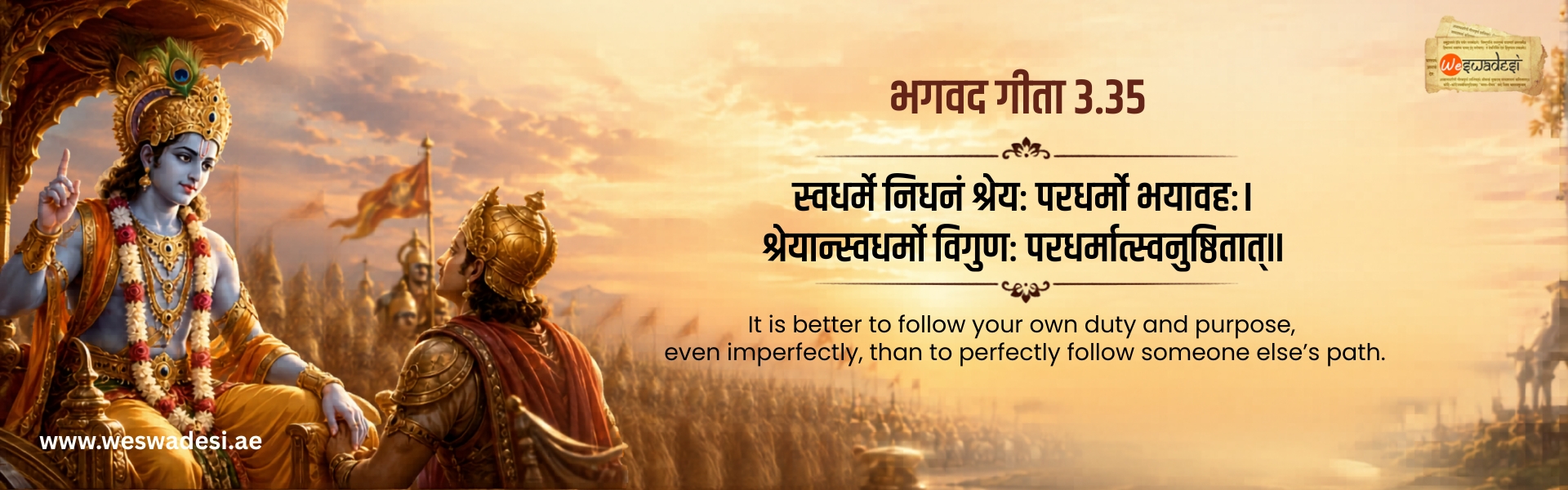
The teachings of the Bhagavad Gita continue to guide millions of people toward peace, clarity, and purpose. Among its most powerful teachings is Bhagavad Gita Updesh Chapter 3 Verse 35, where Lord Krishna explains the importance of following one’s own duty instead of copying others. In today’s world filled with comparison, competition, and confusion, this timeless message is more relevant than ever.
Many people spend their lives trying to become someone else. They compare careers, lifestyles, relationships, achievements, and even spiritual journeys. But Krishna gives a deeply transformative teaching — your own path, even if imperfect, is far better than perfectly following another person’s path.
This verse teaches self-awareness, courage, inner purpose, and spiritual wisdom. It reminds us that real fulfillment comes not from imitation, but from living according to our true nature.
In this detailed blog, you will discover the true meaning of Bhagavad Gita Updesh Chapter 3 Verse 35, its spiritual significance, practical life lessons, psychological relevance, modern-day examples, and how you can apply this wisdom in career, relationships, spirituality, and personal growth.
Bhagavad Gita Chapter 3 Verse 35 Sanskrit Shloka
स्वधर्मे निधनं श्रेयः परधर्मो भयावहः।
श्रेयान्स्वधर्मो विगुणः परधर्मात्स्वनुष्ठितात्॥
Bhagavad Gita Updesh 3-35 : भगवान श्रीकृष्ण कहते हैं कि अपने स्वभाव और कर्तव्य के अनुसार जीवन जीना, चाहे उसमें कठिनाई या कमी हो, दूसरों का मार्ग अपनाने से श्रेष्ठ है।
Transliteration
Svadharme nidhanam shreyah
Paradharmo bhayavahah
Shreyan svadharmo vigunah
Paradharmat svanushthitat
Simple English Meaning
It is better to follow your own duty and purpose, even imperfectly, than to perfectly follow someone else’s path. Living according to your true nature brings peace and growth, while imitating others creates fear and confusion.
Understanding the Core Message of Bhagavad Gita Updesh Chapter 3 Verse 35
This verse revolves around two powerful concepts:
What Is Svadharma?
“Svadharma” means one’s own duty, purpose, natural role, or path in life. It refers to actions aligned with your true nature, abilities, values, and inner calling.
Your svadharma could be:
- Your natural talent
- Your moral responsibility
- Your life purpose
- Your spiritual path
- Your authentic self
Krishna teaches that every individual is unique. Therefore, every person has a unique path.
What Is Paradharma?
“Paradharma” means another person’s path or duty. It refers to imitating someone else’s life instead of discovering your own purpose.
Examples include:
- Choosing a career only because society values it
- Living according to social pressure
- Copying someone else’s success formula
- Ignoring your true nature for external validation
Krishna warns that following another person’s path creates fear, stress, dissatisfaction, and inner conflict.
Why This Teaching Is Extremely Relevant Today
Modern life constantly encourages comparison.
Social media shows:
- Other people’s success
- Wealth
- Beauty
- Achievements
- Relationships
- Careers
As a result, many people:
- Feel inadequate
- Lose confidence
- Forget their individuality
- Chase external approval
- Experience anxiety and burnout
Bhagavad Gita Updesh Chapter 3 Verse 35 gives a direct solution to this modern problem.
Krishna reminds us:
- You are not meant to become someone else
- Your journey is unique
- Your purpose is different
- Inner peace comes from authenticity
This wisdom is deeply important in today’s fast-moving world.
The Deeper Spiritual Meaning of This Verse
This verse is not only about career or worldly success. It has a much deeper spiritual message.
Krishna explains that:
- Every soul has a unique journey
- Spiritual growth happens through authenticity
- Dharma is connected to cosmic order
- Real spirituality is not imitation
Trying to copy another person’s spiritual practice may not work for you.
For example:
- One person grows through meditation
- Another through devotion
- Another through service
- Another through knowledge
Each soul evolves differently.
Krishna encourages self-realization instead of comparison.
Bhagavad Gita Updesh Chapter 3 Verse 35 and Career Choices
One of the biggest applications of this verse is career guidance.
Many people choose careers because:
- Parents pressure them
- Society values certain professions
- Friends influence them
- Money becomes the only goal
As a result:
- They feel emotionally exhausted
- Work becomes meaningless
- Stress increases
- Creativity disappears
Krishna’s teaching suggests:
Choose work aligned with your nature.
Examples
Example 1: The Creative Soul
Someone naturally gifted in art may suffer in a corporate job chosen only for status.
Example 2: The Teacher
A person meant to guide others may feel empty working only for money.
Example 3: The Entrepreneur
Some people are natural leaders and innovators. Suppressing that nature causes frustration.
Bhagavad Gita Updesh Chapter 3 Verse 35 teaches that success without alignment never brings lasting happiness.
The Psychological Wisdom Hidden in This Verse
Modern psychology supports Krishna’s teaching.
Studies show that people experience greater happiness when:
- Their work matches their personality
- Their actions align with values
- They express authenticity
- They stop comparing themselves constantly
Comparison creates:
- Anxiety
- Depression
- Fear of failure
- Low self-worth
Authenticity creates:
- Confidence
- Creativity
- Peace
- Purpose
Krishna explained this wisdom thousands of years ago.
Why Following Someone Else’s Path Creates Fear
The verse specifically uses the word “bhayavahah,” meaning fear-producing.
Why does imitation create fear?
Because:
- You constantly worry about judgment
- You fear failure
- You depend on external approval
- You disconnect from your true self
When you live authentically:
- Fear reduces
- Confidence grows
- Clarity improves
- Decisions become easier
This is why Krishna says even imperfect self-expression is better than perfect imitation.
The Importance of Imperfection
One of the most beautiful parts of this verse is Krishna’s acceptance of imperfection.
He says:
Even if your own path is flawed, it is still superior.
This teaching removes enormous pressure.
You do not need:
- Perfection
- Validation
- Comparison
- External approval
You only need sincerity and authenticity.
This message is deeply healing in a world obsessed with perfection.
Bhagavad Gita Updesh Chapter 3 Verse 35 and Self-Discovery
Before following your dharma, you must understand yourself.
Questions for Self-Reflection
Ask yourself:
- What naturally inspires me?
- What work feels meaningful?
- What activities make me lose track of time?
- What values matter deeply to me?
- What kind of contribution do I want to make?
These questions help reveal your svadharma.
Signs You Are Living Against Your Dharma
You may be disconnected from your true path if you constantly feel:
- Emotionally drained
- Unfulfilled despite success
- Jealous of others
- Confused about purpose
- Spiritually empty
- Forced to pretend
Krishna’s teaching encourages honest self-awareness.
Practical Lessons From Bhagavad Gita Updesh Chapter 3 Verse 35
Stop Comparing Yourself
Every journey is different.
Respect Your Natural Talents
Your uniqueness is valuable.
Accept Imperfection
Growth matters more than perfection.
Follow Meaning Over Social Approval
Inner peace is more important than external validation.
Trust Divine Design
You were created with a unique purpose.
How Students Can Apply This Teaching
Students today face tremendous pressure.
They are constantly compared based on:
- Marks
- Careers
- Colleges
- Salaries
Many choose paths they dislike simply to satisfy others.
Krishna’s message helps students:
- Discover strengths
- Build confidence
- Reduce comparison
- Choose meaningful careers
- Develop emotional balance
A student passionate about design should not feel inferior to someone studying engineering. Every path has value when aligned with one’s nature.
Lessons for Professionals and Business Owners
Professionals often experience burnout because they chase status instead of purpose.
Bhagavad Gita Updesh Chapter 3 Verse 35 teaches:
- Success without purpose feels empty
- Wealth without peace is incomplete
- Authentic work creates deeper fulfillment
Business owners can also apply this wisdom by:
- Building businesses aligned with values
- Avoiding unhealthy competition
- Focusing on meaningful contribution
The Spiritual Freedom of Authentic Living
When you stop pretending:
- Energy increases
- Mental peace improves
- Relationships become genuine
- Creativity flows naturally
Authenticity is spiritual freedom.
Krishna’s wisdom encourages fearless self-expression rooted in dharma.
Real-Life Examples of This Verse
Example: A Musician
A musician forced into a traditional career may earn money but feel emotionally disconnected.
Example: A Spiritual Teacher
Someone called toward spiritual service may suffer while chasing material status.
Example: An Introvert
An introvert copying highly extroverted personalities may feel mentally exhausted.
This verse teaches alignment, not imitation.
Bhagavad Gita Updesh Chapter 3 Verse 35 and Inner Peace
Most stress comes from resistance to our true nature.
When life becomes performance:
- Anxiety increases
- Identity weakens
- Happiness disappears
When actions align with inner truth:
- Peace emerges naturally
- Fear decreases
- Satisfaction increases
This is the hidden secret of dharma.
What Lord Krishna Wants Arjuna to Understand
In the context of the Mahabharata, Arjuna wanted to avoid battle because of emotional confusion.
Krishna reminds him:
- Running away from duty creates suffering
- One must act according to dharma
- Avoiding responsibility out of fear is not spiritual wisdom
This teaching applies to us too.
Sometimes growth requires courage.
Common Misunderstandings About This Verse
Misunderstanding 1: Dharma Means Caste Only
False.
Dharma primarily refers to inner nature, responsibility, and righteous action.
Misunderstanding 2: You Should Never Learn From Others
Krishna is not against learning from others. He warns against losing yourself while copying others.
Misunderstanding 3: Following Passion Means Avoiding Discipline
True dharma still requires dedication, responsibility, and effort.
How to Discover Your Svadharma
Observe Your Natural Strengths
Pay attention to what comes naturally.
Notice What Gives You Energy
Purpose energizes rather than drains.
Reflect Deeply
Silence and introspection reveal truth.
Serve Others
Dharma often involves contribution.
Practice Spiritual Awareness
Meditation and self-awareness help uncover inner purpose.
Bhagavad Gita Updesh Chapter 3 Verse 35 and Social Media Culture
Today’s culture encourages constant comparison.
People compare:
- Income
- Followers
- Lifestyle
- Appearance
- Achievements
This creates:
- Insecurity
- Pressure
- Depression
- Identity confusion
Krishna’s wisdom is a powerful antidote.
You do not need to become viral.
You need to become authentic.
Life Becomes Easier When You Accept Yourself
Acceptance is transformational.
When you stop fighting your nature:
- Decisions become clearer
- Relationships improve
- Mental health strengthens
- Confidence rises
This is why Krishna emphasizes self-aligned living.
The Difference Between Ego and Dharma
Some people confuse ego with purpose.
Ego says:
“I want recognition.”
Dharma says:
“I want meaningful contribution.”
Ego seeks superiority.
Dharma seeks authenticity.
Krishna teaches selfless alignment, not selfish ambition.
The Connection Between Dharma and Karma Yoga
Chapter 3 of the Bhagavad Gita focuses on Karma Yoga — the yoga of selfless action.
This verse teaches:
- Perform your duty sincerely
- Avoid comparison
- Focus on contribution
- Let go of fear
When work becomes dharma, it transforms into spiritual practice.
Bhagavad Gita Updesh Chapter 3 Verse 35 for Modern Youth
Young people today often feel:
- Lost
- Pressured
- Directionless
- Confused about identity
This verse offers clarity:
- You do not need to copy trends
- Your uniqueness matters
- Purpose is more important than popularity
Real fulfillment comes from authenticity.
Powerful Daily Affirmations Inspired by This Verse
- I honor my unique path.
- I trust my inner purpose.
- I do not compare myself with others.
- My authenticity is my strength.
- I grow through sincere effort.
- I follow my dharma fearlessly.
How This Verse Improves Mental Health
Living against your nature creates inner conflict.
This verse encourages:
- Self-acceptance
- Reduced comparison
- Emotional balance
- Authentic living
These principles strongly support mental well-being.
Applying This Teaching in Relationships
Many people change themselves to gain acceptance.
But healthy relationships require authenticity.
Krishna’s wisdom teaches:
- Be genuine
- Respect individuality
- Avoid imitation
- Build relationships rooted in truth
Real connection begins with authenticity.
The Timeless Power of Bhagavad Gita Wisdom
The Bhagavad Gita remains relevant because it addresses universal human struggles:
- Fear
- Comparison
- Purpose
- Duty
- Identity
- Inner peace
Bhagavad Gita Updesh Chapter 3 Verse 35 is one of the greatest teachings on individuality and authenticity ever spoken.
Final Life Lessons From Bhagavad Gita Chapter 3 Verse 35
Here are the greatest lessons from this powerful verse:
- Your path is unique
- Comparison destroys peace
- Imperfect authenticity is better than perfect imitation
- Dharma creates inner harmony
- Fear disappears when you live truthfully
- Purpose matters more than popularity
- Spiritual growth requires self-awareness
- Real success comes from alignment with your true nature
Conclusion
Bhagavad Gita Updesh Chapter 3 Verse 35 gives timeless guidance for modern life. Lord Krishna teaches that each individual has a unique role, purpose, and path. Trying to imitate others may bring temporary approval, but it ultimately creates fear, confusion, and dissatisfaction.
Real peace begins when we accept ourselves fully and live according to our true nature.
In a world obsessed with comparison, this verse reminds us that authenticity is spiritual power.
Even an imperfect life lived truthfully is far greater than a perfect imitation of someone else’s journey.
By understanding and applying the wisdom of Bhagavad Gita Updesh Chapter 3 Verse 35, we can live with greater courage, clarity, peace, and purpose.
FAQs About Bhagavad Gita Updesh Chapter 3 Verse 35
1. What is the meaning of Bhagavad Gita Chapter 3 Verse 35?
It means it is better to follow your own duty and purpose imperfectly than to perfectly imitate someone else’s path.
2. What does svadharma mean?
Svadharma means one’s own duty, purpose, natural role, or authentic path in life.
3. Why does Krishna warn against paradharma?
Because following another person’s path creates fear, confusion, and inner conflict.
4. How is this verse relevant today?
It helps people overcome comparison, social pressure, and identity confusion in modern life.
5. Does this verse apply to careers?
Yes. Krishna encourages people to choose work aligned with their natural abilities and values.
6. What is the spiritual message of this verse?
Every soul has a unique journey. Spiritual growth comes through authenticity.
7. How can I discover my svadharma?
Through self-awareness, reflection, service, and understanding your natural strengths and values.
8. Does this verse support individuality?
Yes. It strongly supports authentic living and respecting one’s unique nature.
9. Why is comparison harmful according to the Gita?
Comparison disconnects people from their true selves and creates fear and dissatisfaction.
10. What is the main lesson of Bhagavad Gita Updesh Chapter 3 Verse 35?
True success and peace come from following your own dharma with sincerity and courage.
Suggested Internal Links
- Bhagavad Gita Chapter 2 Verse 47 Meaning
- Bhagavad Gita Chapter 6 Verse 26 Explanation
- Bhagavad Gita Chapter 12 Verse 17 Meaning
- Karma Yoga Teachings in Bhagavad Gita
- Lord Krishna’s Best Motivational Quotes
- How to Find Your Life Purpose Spiritually
- Bhagavad Gita Lessons for Students
- Bhagavad Gita Teachings on Mental Peace
