
- Your cart is empty
- Continue Shopping
Bhishma Pitamaha: The Grand Guardian of Dharma, Duty & Sacrifice

Introduction
Among the most revered and complex personalities in the Mahabharata, Bhishma stands as a towering symbol of sacrifice, loyalty, and dharma. Known as Bhishma Pitamaha, the grandfather of the Kuru dynasty, his life is a remarkable blend of strength, wisdom, and tragic choices.
Though not the central speaker of the Bhagavad Gita, Bhishma’s presence in the Kurukshetra war deeply influences its events and teachings. His life reflects the eternal struggle between personal morality and duty—a theme that lies at the heart of the Gita.
Key Facts About Bhishma
- Birth Name: Devavrata
- Parents: King Shantanu and Goddess Ganga
- Title: Bhishma Pitamaha
- Vow: Lifelong celibacy and loyalty to the throne
- Divine Boon: Iccha Mrityu (power to choose time of death)
- Role in War: Commander of Kaurava army (first 10 days)
Birth and Divine Origin
Bhishma was born as Devavrata, the son of King Shantanu and the river goddess Ganga. He was the incarnation of one of the eight Vasus, celestial beings cursed to live on earth.
From childhood, he exhibited:
- Extraordinary intelligence
- Exceptional warrior skills
- Deep understanding of dharma
He was trained by great masters, including the legendary sage Parashurama, making him one of the most powerful warriors of his time.
The Terrible Vow: Bhishma Pratigya
The defining moment of Bhishma’s life came when his father, Shantanu, wished to marry Satyavati. However, her father demanded that her future son inherit the throne.
To fulfill his father’s desire, Devavrata took a terrible vow:
- He renounced his claim to the throne
- He vowed lifelong celibacy
“ब्रह्मचर्यं चरिष्यामि यावज्जीवितमात्मनः ।
न च राज्यं करिष्यामि सत्यवत्याः सुतो भवेत् ॥”
Meaning:
“I shall observe celibacy throughout my life, and I shall never claim the throne, so that Satyavati’s son may become king.”
His lifelong loyalty to the throne of Hastinapura is understood through his actions and oath of service, though that exact modern Hindi sentence does not appear verbatim in the original Sanskrit Mahabharata.
This vow shocked the heavens, and the gods named him “Bhishma,” meaning one who takes a terrible oath.
The Blessing of Iccha Mrityu
Impressed by his sacrifice, his father granted him:
- The power to choose the time of his death
This made Bhishma nearly invincible.
Bhishma Pratigya: The Terrible Vow That Changed the Mahabharata Forever
Among the most powerful moments in the Mahabharata, the Bhishma Pratigya stands as a timeless symbol of sacrifice, duty, and devotion. This extraordinary vow transformed Prince Devavrata into Bhishma and altered the destiny of the Kuru dynasty forever.
The vow is remembered not only for its intensity but also for the deep emotional and moral consequences it carried throughout the Mahabharata.
Who Was Devavrata Before Becoming Bhishma?
Before becoming Bhishma Pitamaha, he was known as Devavrata, the son of:
- King Shantanu
- Goddess Ganga
He was:
- Exceptionally intelligent
- A master warrior
- Trained by great sages including Parashurama
- The rightful heir to the throne of Hastinapura
Devavrata was admired by everyone and was considered the ideal prince.
Why Did Bhishma Take the Terrible Vow?
The story begins when King Shantanu fell in love with Satyavati, the daughter of a fisherman.
However, Satyavati’s father placed one condition:
- Only Satyavati’s future son should become king of Hastinapura.
This created a major problem because:
- Devavrata was already the crown prince.
King Shantanu, unable to break his promise to Devavrata and unwilling to force the marriage, became deeply saddened.
Seeing his father’s pain, Devavrata decided to sacrifice everything for his happiness.
The Bhishma Pratigya (Terrible Vow)
Devavrata went to the fisherman and made a historic declaration:
“मैं आजीवन ब्रह्मचर्य का पालन करूँगा और हस्तिनापुर के सिंहासन पर कभी अधिकार नहीं करूँगा।”
Meaning
“I shall remain celibate for life and never claim the throne of Hastinapura.”
But the vow did not stop there.
He further promised:
- He would never marry
- He would never have children
- He would dedicate his entire life to protecting the throne of Hastinapura
This ensured that:
- No future son of Devavrata could challenge Satyavati’s lineage.
Why Was It Called ‘Bhishma’ Pratigya?
The word “Bhishma” means:
- Terrible
- Fearsome
- Awe-inspiring
The gods themselves were shocked by the severity of the vow.
They declared:
“This is a Bhishana Pratigya” (terrible vow)
From that day onward, Devavrata became known as Bhishma.
The Blessing of Iccha Mrityu
King Shantanu was overwhelmed by his son’s sacrifice.
As a blessing, he granted Bhishma:
- Iccha Mrityu — the power to choose the time of his death.
This divine boon made Bhishma nearly invincible.
The Deeper Meaning of Bhishma Pratigya
The Bhishma Pratigya is not merely about celibacy.
It symbolizes:
- Ultimate sacrifice
- Devotion toward parents
- Renunciation of personal desires
- Commitment to duty
However, it also raises important questions:
- Can duty become too rigid?
- Should sacrifice come at the cost of personal happiness?
- Can loyalty blind someone from justice?
These questions make Bhishma one of the most complex characters in the Mahabharata.
How the Vow Changed the Mahabharata
Bhishma’s vow had far-reaching consequences.
Because he never married or became king:
- The Kuru dynasty faced succession crises
- Weak rulers later ascended the throne
- Conflicts between Kauravas and Pandavas intensified
In many ways, Bhishma’s vow indirectly shaped:
- The Kurukshetra War
- The events leading to the Bhagavad Gita
Bhishma’s Loyalty to the Throne
After taking the vow, Bhishma dedicated his life to Hastinapura.
He:
- Protected the kingdom for generations
- Served as advisor and guardian
- Remained loyal to the throne regardless of the ruler
Even during the Kurukshetra War:
- He fought for the Kauravas because of his vow
- Though emotionally he loved the Pandavas
This reveals the tragic side of Bhishma’s commitment.
Bhishma Pratigya and Dharma
Bhishma’s vow represents both:
- The greatness of sacrifice
- The complexity of dharma
The Mahabharata shows that:
- Duty without flexibility can create suffering
- Loyalty without questioning may lead to injustice
Bhishma’s silence during Draupadi’s humiliation is often linked to his rigid adherence to duty.
Lessons from Bhishma Pratigya
1. Sacrifice is Powerful
Bhishma gave up everything for his father’s happiness.
2. Duty Must Be Balanced
Extreme commitment without wisdom can become harmful.
3. Promises Carry Responsibility
Every vow has consequences.
4. Selflessness Inspires Respect
Bhishma became immortal in history because of his sacrifice.
5. Dharma is Complex
Sometimes choosing the right path is not easy.
Famous Dialogue of Bhishma Pratigya
“मैं हस्तिनापुर के सिंहासन का त्याग करता हूँ और आजीवन ब्रह्मचर्य का पालन करूँगा।”
This declaration remains one of the most iconic moments in Indian epic history.
Bhishma Pratigya in Modern Life
Even today, Bhishma’s vow inspires people to:
- Respect parents
- Honor commitments
- Live with discipline and integrity
At the same time, it teaches:
- Not to lose balance in duty
- To combine commitment with wisdom
Role in the Kuru Dynasty
Bhishma became the pillar of the Kuru kingdom.
He:
- Served as regent and advisor
- Protected the kingdom across generations
- Guided both Kauravas and Pandavas
He arranged marriages, ensured stability, and upheld royal traditions.
However, his greatest challenge was balancing:
- Loyalty to the throne
- Commitment to dharma
The Moral Conflict: Draupadi’s Humiliation
One of the most debated moments in Bhishma’s life is his silence during the humiliation of Draupadi in the royal court.
Despite knowing the act was wrong, Bhishma:
- Did not intervene
- Remained bound by loyalty to the throne
This moment highlights:
- The limitations of rigid duty
- The complexity of dharma
- The consequences of inaction
Bhishma in the Kurukshetra War
When the Kurukshetra war began, Bhishma chose to fight for the Kauravas.
Why Did He Fight for the Kauravas?
- His vow bound him to serve the throne of Hastinapura
- He could not abandon his duty
However:
- He loved the Pandavas
- He did not wish to harm them
This inner conflict made his role deeply tragic.
Commander of the Kaurava Army
Bhishma served as the commander of the Kaurava army for the first ten days.
During this time:
- He was nearly invincible
- No warrior could defeat him
- He displayed unmatched skill and strength
Even great warriors like Arjuna struggled against him.
The Fall of Bhishma
Bhishma had one weakness—he would not fight a woman or someone who had been a woman.
The Pandavas used this to their advantage:
- Shikhandi was placed before Arjuna
- Bhishma refused to attack Shikhandi
- Arjuna shot arrows, bringing Bhishma down
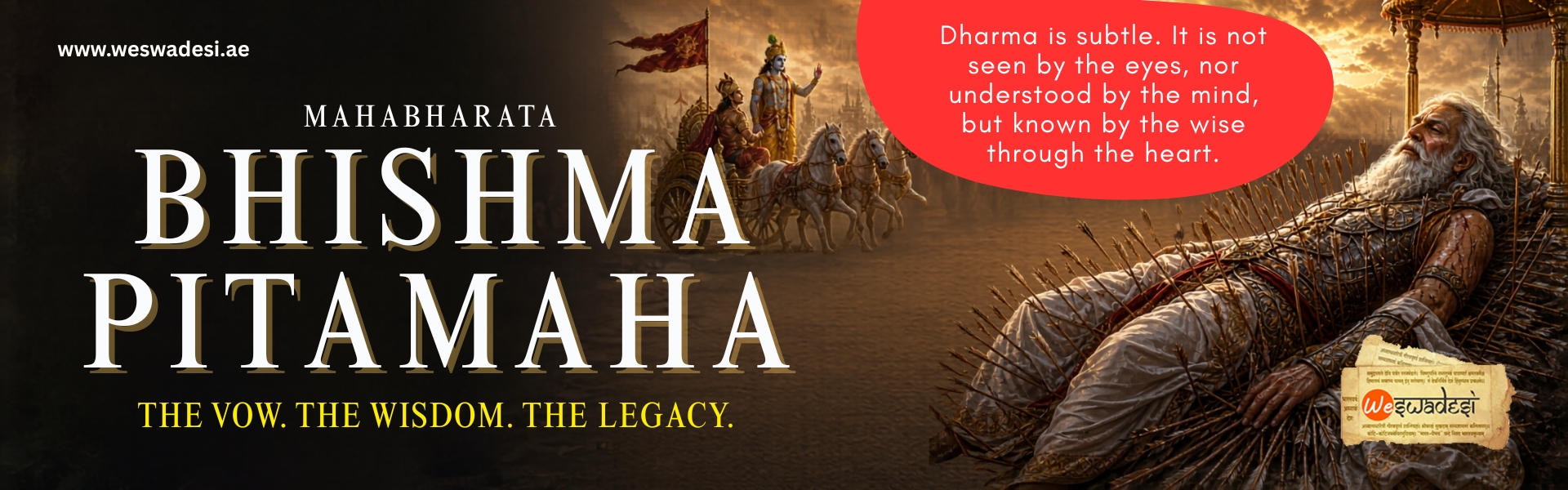
He fell onto a bed of arrows, a powerful and symbolic moment in the epic.
The Bed of Arrows
Even after falling, Bhishma did not die.
Using his boon of Iccha Mrityu:
- He chose to remain alive
- Waited for the auspicious time of Uttarayana
Lying on the bed of arrows, he:
- Continued to guide others
- Shared wisdom and teachings
Bhishma’s Teachings
During his final days, Bhishma imparted profound knowledge to Yudhishthira.
These teachings form:
- Shanti Parva
- Anushasana Parva
Topics Covered
- Dharma (righteousness)
- Kingship and leadership
- Ethics and duty
- Governance and justice
He also recited the sacred Vishnu Sahasranama, emphasizing devotion and spirituality.
Bhishma and the Bhagavad Gita
Although Bhishma is not a speaker in the Bhagavad Gita, his presence shapes its context.
His role:
- Represents duty-bound action
- Reflects the complexity of dharma
- Influences Arjuna’s emotional conflict
Bhishma’s life contrasts with Krishna’s teachings:
- Krishna promotes balanced action with wisdom
- Bhishma represents rigid adherence to duty
Symbolism of Bhishma
Bhishma embodies several powerful ideals:
1. Sacrifice
He gave up personal happiness for his father.
2. Loyalty
He remained committed to the throne.
3. Duty
He upheld his vows at all costs.
4. Moral Conflict
His life reflects the struggle between right and obligation.
Lessons from Bhishma
1. Duty Must Be Balanced with Morality
Blind loyalty can lead to injustice.
2. Sacrifice is Noble but Complex
Every sacrifice has consequences.
3. Speak Against Wrong
Silence can be as harmful as action.
4. Leadership Requires Courage
A leader must act, not just observe.
5. Wisdom Comes with Experience
Bhishma’s teachings remain relevant even today.
Relevance in Modern Life
Bhishma’s story resonates strongly in today’s world.
We often face:
- Conflicts between job and ethics
- Family vs professional responsibilities
- Difficult moral decisions
Bhishma teaches:
- Think beyond rigid rules
- Balance duty with compassion
- Make ethical choices
Bhishma for Devotees in UAE
For Indians living in the UAE, Bhishma’s story is a reminder of:
- Cultural values
- Respect for elders
- Importance of dharma
Through platforms like weswadesi.ae, devotees can:
- Access spiritual books
- Learn about Mahabharata
- Stay connected to traditions
Cultural and Spiritual Legacy
Bhishma remains one of the most respected figures in Indian tradition.
In Religion
- Revered as a wise elder
- Symbol of sacrifice
In Literature
- Central character in Mahabharata
- Source of ethical teachings
In Arts
- Depicted in paintings and performances
- Celebrated in storytelling traditions
Conclusion
Bhishma Pitamaha’s life is a powerful blend of greatness and tragedy. His unwavering commitment to duty made him legendary, but his inability to act against injustice reveals the complexity of dharma.
He teaches us that:
- Duty alone is not enough
- Wisdom must guide action
- Courage is required to stand for truth
Bhishma is not just a warrior—he is a timeless lesson in leadership, sacrifice, and moral responsibility.
FAQs About Bhishma
1. Who was Bhishma in the Mahabharata?
Bhishma was the grandfather of the Kuru dynasty and a great warrior known for his vow of celibacy.
2. Why did Bhishma take a vow of celibacy?
He took the vow to fulfill his father’s wish to marry Satyavati and ensure her children would inherit the throne.
3. How did Bhishma die?
He was brought down by Arjuna using Shikhandi and lay on a bed of arrows until choosing his time of death.
4. What is Iccha Mrityu?
It is the power to choose the moment of death, granted to Bhishma as a boon.
5. What can we learn from Bhishma?
We learn about duty, sacrifice, and the importance of balancing loyalty with righteousness.
