

- Your cart is empty
- Continue Shopping
Bhagavad Gita Chapter 6 Verse 5 – Meaning, Explanation, Life Lessons & Importance in Daily Life

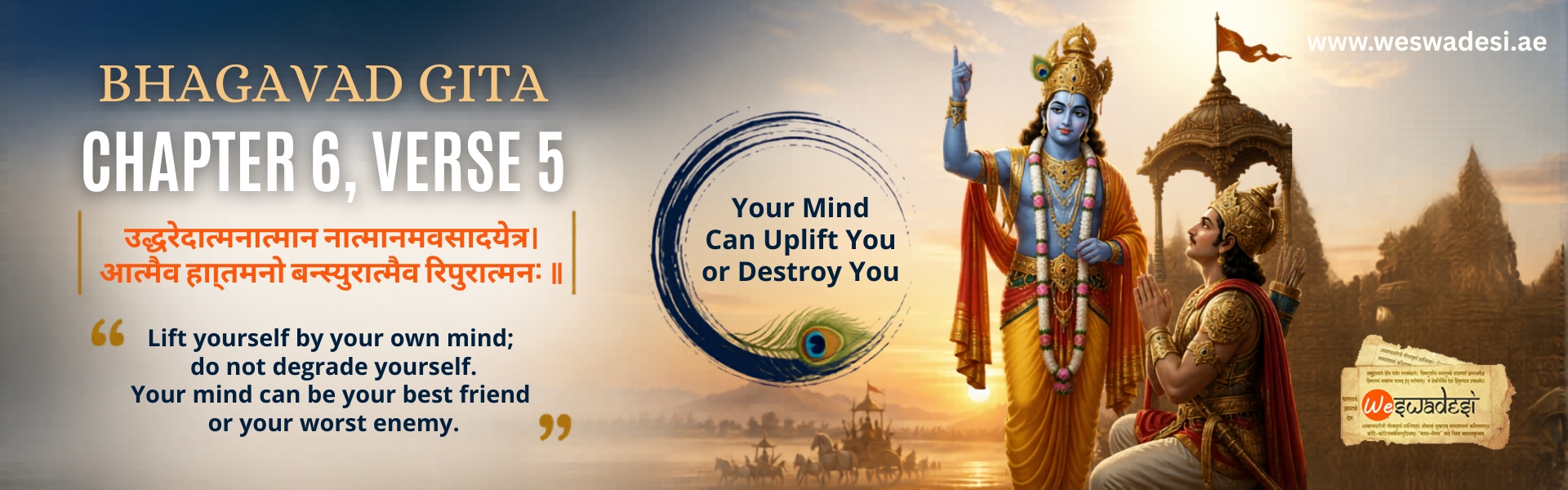
Bhagavad Gita 6.5 Sanskrit Shloka
उद्धरेदात्मनाऽत्मानं नात्मानमवसादयेत्।
आत्मैव ह्यात्मनो बन्धुरात्मैव रिपुरात्मनः॥
Transliteration
Uddhared ātmanātmānaṁ nātmānam avasādayet
Ātmaiva hyātmano bandhur ātmaiva ripur ātmanaḥ
Meaning of Bhagavad Gita Chapter 6 Verse 5
This profound verse from the Bhagavad Gita teaches one of the most important truths of human life: our own mind can either uplift us or destroy us.
Lord Krishna advises Arjuna to elevate himself through self-discipline, positive thinking, and spiritual awareness. One should never allow the mind to drag oneself into negativity, laziness, fear, or despair.
The verse explains that:
- A controlled mind becomes our greatest friend.
- An uncontrolled mind becomes our biggest enemy.
This teaching is timeless and highly relevant in today’s world filled with stress, distractions, anxiety, and emotional struggles.
Simple Meaning (English)
You should lift yourself up by your own efforts, and not bring yourself down.
Because your own mind can be your best friend or your worst enemy.
🔹 सरल अर्थ (Hindi)
मनुष्य को चाहिए कि वह अपने प्रयासों से खुद को ऊपर उठाए, और खुद को नीचे गिरने न दे।
क्योंकि मन ही मनुष्य का सबसे बड़ा मित्र भी है और सबसे बड़ा शत्रु भी।
🔹 Deeper Understanding (Common Explanation)
This shlok teaches that:
- You are responsible for your own growth.
- Your mind (आत्मा/मन) plays the key role.
- If you control your thoughts → you succeed.
- If your thoughts control you → you suffer.
Easy Real-Life Example
📌 Example: Student Life
Imagine two students:
👉 Student A (Mind as Friend)
- Wakes up on time
- Studies regularly
- Avoids distractions like excessive phone use
- Encourages himself: “I can do it”
➡️ Result: Success, confidence, peace
👉 Student B (Mind as Enemy)
- Keeps delaying work
- Uses phone all day
- Thinks: “I can’t do this”
- Gives up easily
Result: Stress, failure, regret
Key Message
- Control your mind → it helps you grow
- Lose control → it destroys your progress
🔹 One-Line Summary
👉 “Your biggest support and your biggest obstacle — both are inside you.”
Context of Bhagavad Gita Chapter 6
Chapter 6 of the Bhagavad Gita is known as:
Dhyana Yoga – The Yoga of Meditation
In this chapter, Lord Krishna explains:
- Self-control
- Meditation
- Discipline of the mind
- Spiritual growth
- Inner peace
Verse 5 appears when Krishna teaches Arjuna the importance of mastering the mind before attempting spiritual realization.
The battlefield of Kurukshetra is not only external; it is also internal. Every human being fights battles within the mind:
- Fear vs courage
- Discipline vs laziness
- Positivity vs negativity
- Wisdom vs temptation
Krishna’s message is clear:
Victory begins within.
Word-by-Word Meaning of the Shloka
उद्धरेत् (Uddharet)
To uplift, elevate, or rise higher.
आत्मना (Atmana)
By oneself, through one’s own mind or inner self.
आत्मानम् (Atmanam)
The self, personality, or consciousness.
न अवसादयेत् (Na Avasadayet)
Do not degrade or weaken yourself.
बन्धुः (Bandhuh)
Friend, supporter, helper.
रिपुः (Ripuh)
Enemy, destroyer.
Deep Explanation of Bhagavad Gita 6.5
1. Human Beings Shape Their Own Destiny
This verse teaches personal responsibility.
Lord Krishna does not tell Arjuna to depend entirely on luck, destiny, or external help. Instead, He says:
“Raise yourself by yourself.”
This means:
- Your thoughts shape your future.
- Your habits shape your character.
- Your actions shape your destiny.
A person who develops discipline, wisdom, and positive thinking gradually rises in life spiritually, emotionally, and materially.
2. The Mind Is the Greatest Power
The human mind is extremely powerful.
It can:
- Create confidence
- Generate creativity
- Build success
- Develop spiritual awareness
But the same mind can also:
- Create fear
- Cause depression
- Increase anger
- Lead to addiction
- Destroy peace
Therefore, Krishna emphasizes mastering the mind.
Modern psychology also confirms this truth:
Thoughts influence emotions, behavior, and life outcomes.
The Bhagavad Gita explained this thousands of years ago.
3. Self-Control Leads to Freedom
People often think freedom means doing anything they want.
But according to the Bhagavad Gita:
True freedom comes from mastery over desires and emotions.
A person controlled by anger, greed, jealousy, or addiction is not truly free.
When the mind becomes disciplined:
- Decision-making improves
- Emotional balance increases
- Relationships become healthier
- Spiritual awareness grows
The Mind as a Friend
Krishna says:
“The mind can become your best friend.”
How?
A disciplined mind:
- Encourages positive thinking
- Supports good habits
- Helps in meditation
- Inspires confidence
- Maintains peace during difficulties
- Motivates self-improvement
Example:
A student with a focused mind studies consistently and succeeds.
An athlete with mental discipline performs better under pressure.
A spiritual seeker with a calm mind experiences inner peace.
The Mind as an Enemy
An uncontrolled mind creates suffering.
Negative mental patterns include:
- Overthinking
- Laziness
- Fear
- Anger
- Ego
- Jealousy
- Addiction
- Self-doubt
Such tendencies slowly weaken a person from within.
Example:
A person may know what is right but still fail due to lack of mental discipline.
This is why Krishna says:
“Do not degrade yourself.”
Importance of Bhagavad Gita 6.5 in Modern Life
This verse is extremely practical even today.
1. Mental Health
Modern society faces:
- Anxiety
- Stress
- Depression
- Emotional exhaustion
Bhagavad Gita 6.5 teaches:
- Self-awareness
- Positive thinking
- Emotional discipline
- Mental balance
Meditation and self-control are now recommended globally for mental wellness.
2. Social Media & Distractions
Today’s world constantly distracts the mind:
- Social media addiction
- Comparison with others
- Negative news
- Endless entertainment
An uncontrolled mind becomes restless.
Krishna’s teaching reminds us:
Control technology before technology controls your mind.
3. Career and Success
Success requires:
- Consistency
- Focus
- Self-belief
- Discipline
A distracted mind wastes opportunities.
A focused mind creates growth.
4. Spiritual Growth
Spirituality begins with inner mastery.
Without controlling the mind:
- Meditation becomes difficult
- Anger increases
- Peace disappears
Krishna teaches that spiritual elevation begins from self-discipline.
Connection Between Mind and Karma
The Bhagavad Gita repeatedly explains:
Thoughts lead to actions.
Actions create karma.
Therefore:
- Pure thoughts create positive karma.
- Negative thinking creates suffering.
Controlling the mind is essential for living a righteous and peaceful life.
Practical Life Lessons from Bhagavad Gita 6.5
1. Stop Negative Self-Talk
Never continuously tell yourself:
- “I cannot do this.”
- “I am a failure.”
- “Nothing will improve.”
Such thoughts weaken the mind.
Instead:
- Develop confidence
- Focus on growth
- Believe in self-improvement
2. Build Positive Habits
Daily habits shape the mind.
Helpful habits:
- Meditation
- Reading spiritual texts
- Exercise
- Gratitude
- Discipline
- Positive company
3. Avoid Toxic Influences
Your environment affects your mind.
Avoid:
- Negative people
- Harmful addictions
- Excessive negativity
- Unhealthy comparisons
Choose uplifting influences.
4. Practice Meditation
Meditation helps:
- Calm the mind
- Improve concentration
- Reduce stress
- Increase self-awareness
This is why Chapter 6 focuses heavily on meditation.
5. Take Responsibility for Your Growth
Blaming others weakens personal power.
Krishna teaches self-responsibility:
Become the creator of your own upliftment.
Spiritual Interpretation of the Verse
On a deeper spiritual level:
- The lower mind seeks temporary pleasures.
- The higher self seeks truth and liberation.
The spiritual journey involves:
- Controlling lower impulses
- Awakening higher consciousness
- Realizing the divine self
Thus, this verse is also a guide toward self-realization.
Teachings of Great Saints on This Verse
Adi Shankaracharya
Adi Shankaracharya explained that self-control and discrimination are necessary for liberation.
Without conquering the mind, spiritual progress becomes impossible.
Swami Vivekananda
Swami Vivekananda often emphasized:
“You are the maker of your own destiny.”
This reflects the same wisdom of Bhagavad Gita 6.5.
He encouraged strength, discipline, and positive thinking.
Mahatma Gandhi
Gandhi practiced self-discipline and inner control throughout his life.
He believed:
True change begins from within.
Scientific Relevance of Bhagavad Gita 6.5
Modern neuroscience shows:
- Thoughts create neural pathways.
- Repeated thinking patterns shape behavior.
- Positive mental training improves well-being.
Practices like:
- Meditation
- Mindfulness
- Self-reflection
are scientifically proven to improve mental health.
The Bhagavad Gita anticipated these truths long ago.
How to Apply Bhagavad Gita 6.5 Daily
Morning Practices
- Wake up early
- Practice gratitude
- Read spiritual wisdom
- Meditate for 10 minutes
During Work
- Stay focused
- Avoid distractions
- Maintain calmness
- Respond wisely, not emotionally
During Difficult Times
- Avoid panic
- Control negative thoughts
- Trust your inner strength
- Remain patient
Before Sleeping
- Reflect on the day
- Release negativity
- Pray or meditate
Why This Verse Is So Powerful
Bhagavad Gita 6.5 is powerful because it shifts responsibility inward.
Instead of blaming:
- Society
- Circumstances
- Luck
- Other people
Krishna teaches:
The greatest transformation begins within your own mind.
This wisdom empowers individuals to:
- Rise above suffering
- Develop inner strength
- Achieve peace
- Move toward spiritual realization
Key Takeaways from Bhagavad Gita 6.5
- Your mind can uplift or destroy you.
- Self-discipline is essential for success.
- Positive thinking creates inner strength.
- Meditation helps control the mind.
- Personal responsibility leads to growth.
- Spiritual progress begins with mental mastery.
- Inner victory is greater than external victory.
Conclusion
Bhagavad Gita Chapter 6 Verse 5 offers one of the most transformative teachings in spiritual literature.
Lord Krishna reminds humanity that:
The greatest battle is not outside—it is within the mind.
Every person has the power to:
- Rise above negativity
- Develop discipline
- Build inner peace
- Achieve spiritual wisdom
When the mind is controlled, it becomes a loyal friend guiding us toward success, peace, and enlightenment.
But when left uncontrolled, it becomes the source of suffering and confusion.
This timeless verse inspires us to take charge of our thoughts, actions, and destiny.
In today’s stressful and distracted world, the wisdom of Bhagavad Gita 6.5 is more relevant than ever.
FAQs on Bhagavad Gita Chapter 6 Verse 5
1. What is the meaning of Bhagavad Gita 6.5?
Bhagavad Gita 6.5 teaches that a person should uplift oneself through self-discipline and positive thinking because the mind can become either a friend or an enemy.
2. Why is the mind called both friend and enemy?
A controlled mind supports peace, wisdom, and growth, while an uncontrolled mind creates negativity, fear, anger, and suffering.
3. Which chapter contains this verse?
This verse appears in Chapter 6 of the Bhagavad Gita, known as Dhyana Yoga or the Yoga of Meditation.
4. How can we control the mind according to the Bhagavad Gita?
The Bhagavad Gita recommends:
- Meditation
- Discipline
- Positive habits
- Detachment
- Self-awareness
- Spiritual practice
5. What is the importance of Bhagavad Gita 6.5 in modern life?
This verse helps people deal with stress, anxiety, distractions, emotional imbalance, and lack of focus in modern society.
6. What does “lift yourself by yourself” mean?
It means personal growth begins through self-effort, discipline, and conscious improvement rather than blaming others.
7. How does this verse relate to mental health?
It emphasizes the importance of healthy thinking, emotional balance, and self-control, which are essential for mental well-being.
8. Can meditation help make the mind a friend?
Yes. Meditation calms the mind, improves focus, reduces stress, and helps develop inner peace.
9. What are the practical lessons from Bhagavad Gita 6.5?
Key lessons include:
- Avoid negative thinking
- Practice self-discipline
- Build positive habits
- Stay mentally strong
- Focus on self-improvement
10. Why is Bhagavad Gita 6.5 considered timeless wisdom?
Because every generation struggles with the mind, emotions, and inner conflict. This verse provides universal guidance for self-mastery and peaceful living.
