
- Your cart is empty
- Continue Shopping
Dhritarashtra: The Blind King of Mahabharata & Symbol of Moral Conflict

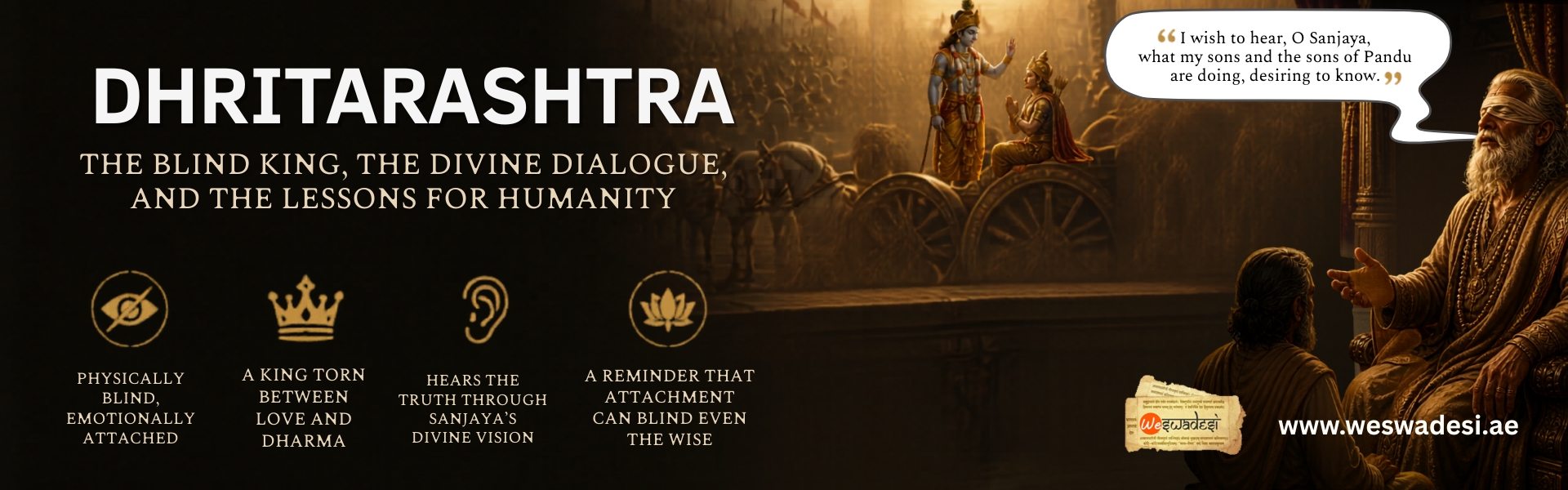
In the grand narrative of the Mahabharata, few characters are as complex and emotionally layered as Dhritarashtra. Known as the blind king of Hastinapura, Dhritarashtra represents the deep conflict between love and duty, attachment and righteousness.
While he was a powerful ruler and a devoted father, his inability to act justly in critical moments led to one of the greatest wars in history—the Kurukshetra War, which forms the backdrop of the Bhagavad Gita.
Dhritarashtra’s story is not just about physical blindness—it is a profound metaphor for moral and spiritual ignorance.
Key Facts About Dhritarashtra
- Parents: Vyasa and Ambika
- Spouse: Gandhari
- Children: 100 sons (Kauravas) and one daughter (Duhsala)
- Kingdom: Hastinapura
- Advisor: Vidura
- Narrator to him: Sanjaya
- Symbolism: Moral blindness and attachment
Birth and Early Life
Dhritarashtra was born to Vyasa and Queen Ambika. Due to fear during conception, Ambika closed her eyes, resulting in Dhritarashtra being born blind.
Because of his blindness:
- He was initially denied the throne
- His younger brother Pandu became king
However, after Pandu’s retirement, Dhritarashtra ascended the throne of Hastinapura.
Marriage to Gandhari
Dhritarashtra married Gandhari, who is remembered for her extraordinary act of devotion.
In solidarity with her husband:
- Gandhari blindfolded herself for life
- She chose to share his darkness
Together, they had:
- 100 sons (the Kauravas)
- 1 daughter, Duhsala
Their eldest son, Duryodhana, became the central antagonist of the Mahabharata.
Dhritarashtra as a King
Dhritarashtra was not inherently evil. In fact, he possessed:
- Compassion
- Intelligence
- Understanding of dharma
However, his greatest weakness was attachment to his sons, especially Duryodhana.
His Leadership Challenges
- Inability to control Duryodhana
- Failure to enforce justice
- Dependence on advisors for decisions
Despite knowing what was right, he often failed to act.
The Dice Game: A Turning Point
One of the most critical moments in Dhritarashtra’s reign was the infamous dice game.
During this event:
- The Pandavas were cheated and lost everything
- Draupadi was humiliated in court
Dhritarashtra:
- Remained silent during the injustice
- Failed to stop the humiliation
This moment marked:
- The collapse of dharma in his kingdom
- The beginning of inevitable conflict
Counsel Ignored: Vidura and Sanjaya
Dhritarashtra was surrounded by wise advisors:
Vidura
- Symbol of wisdom and righteousness
- Constantly advised peace and justice
Sanjaya
- Narrator of the war
- Voice of truth and clarity
Despite their guidance, Dhritarashtra chose to follow his emotional attachment rather than dharma.
Dhritarashtra and the Bhagavad Gita
The Bhagavad Gita begins with Dhritarashtra’s famous question to Sanjaya:
“What did my sons and the sons of Pandu do on the battlefield of Kurukshetra?”
This question reveals:
- His concern for his sons
- His awareness of impending conflict
- His passive role in the situation
Throughout the Gita, Dhritarashtra remains a listener—not an actor.
Symbolism of Dhritarashtra
Dhritarashtra’s blindness is deeply symbolic.
1. Physical Blindness
He cannot see the world around him.
2. Moral Blindness
He fails to distinguish right from wrong in action.
3. Emotional Blindness
His love for his sons clouds his judgment.
Dhritarashtra vs Dharma
Dhritarashtra’s life is a constant struggle between:
- Love for his family
- Responsibility as a king
He knows:
- Duryodhana is wrong
- Pandavas are rightful heirs
Yet, he chooses:
- Silence over action
- Attachment over justice
This makes him one of the most tragic figures in the Mahabharata.
The Kurukshetra War and Its Consequences
Dhritarashtra’s inaction ultimately leads to the Kurukshetra War.
The results:
- Destruction of his entire lineage
- Death of all 100 sons
- Collapse of the Kuru dynasty
Through Sanjaya’s narration, he witnesses the downfall of everything he tried to protect.
The Grief of a Father
After the war, Dhritarashtra is overwhelmed with grief.
In a famous incident:
- He attempts to embrace Bhima
- Out of anger, he tries to crush him
However:
- Krishna replaces Bhima with an iron statue
- Dhritarashtra unknowingly destroys it
This moment reflects:
- His suppressed rage
- His deep sorrow
- His tragic helplessness
Later Life and Renunciation
After the war:
- Dhritarashtra renounces royal life
- Leaves for the forest with Gandhari and Kunti
He spends his final days in:
- Reflection
- Repentance
- Spiritual withdrawal
Eventually, he dies in a forest fire, marking the end of his journey.
Lessons from Dhritarashtra
1. Attachment Can Blind Judgment
Excessive love without balance leads to poor decisions.
2. Inaction is Also a Choice
Failing to act against wrong is equal to supporting it.
3. Leadership Requires Courage
A leader must uphold justice, even against family.
4. Listen to Wise Counsel
Ignoring good advice leads to downfall.
5. Dharma Must Come First
Righteousness should never be compromised.
Relevance in Modern Life
Dhritarashtra’s story is highly relevant today.
In modern society, we see:
- Leaders avoiding tough decisions
- People favoring personal relationships over fairness
- Emotional bias affecting judgment
His story teaches:
- Be fair and objective
- Stand for what is right
- Balance emotion with responsibility
Dhritarashtra for Devotees in UAE
For Indians living in the UAE, Dhritarashtra’s story serves as a reminder of:
- Ethical leadership
- Importance of dharma
- Cultural values
Through platforms like weswadesi.ae, devotees can:
- Read scriptures like the Bhagavad Gita
- Teach children moral lessons
- Stay connected to Indian heritage
Cultural and Philosophical Impact
Dhritarashtra remains a powerful figure in:
- Literature
- Theatre and television
- Spiritual discussions
He is often studied as:
- A tragic king
- A flawed leader
- A symbol of moral weakness
Conclusion
Dhritarashtra’s life is a powerful reminder that true blindness is not of the eyes—but of the mind and heart.
Despite having wisdom, advisors, and opportunities, he failed to act when it mattered most.
His story teaches us:
- To act with courage
- To choose dharma over attachment
- To lead with fairness and integrity
Dhritarashtra is not just a character—he is a lesson in leadership, responsibility, and the consequences of moral compromise.
FAQs About Dhritarashtra
1. Who was Dhritarashtra?
Dhritarashtra was the blind king of Hastinapura and father of the Kauravas in the Mahabharata.
2. Why is Dhritarashtra considered a tragic figure?
Because he knew what was right but failed to act due to attachment to his sons.
3. What does Dhritarashtra symbolize?
He symbolizes moral blindness, emotional attachment, and flawed leadership.
4. What was Dhritarashtra’s role in the Bhagavad Gita?
He was the listener to whom Sanjaya narrated the events of the battlefield.
5. What can we learn from Dhritarashtra?
To prioritize dharma over attachment and to act courageously in difficult situations.
