

- Your cart is empty
- Continue Shopping
Ashwatthama: The Immortal Warrior of Curse, Karma & Consequence

Introduction
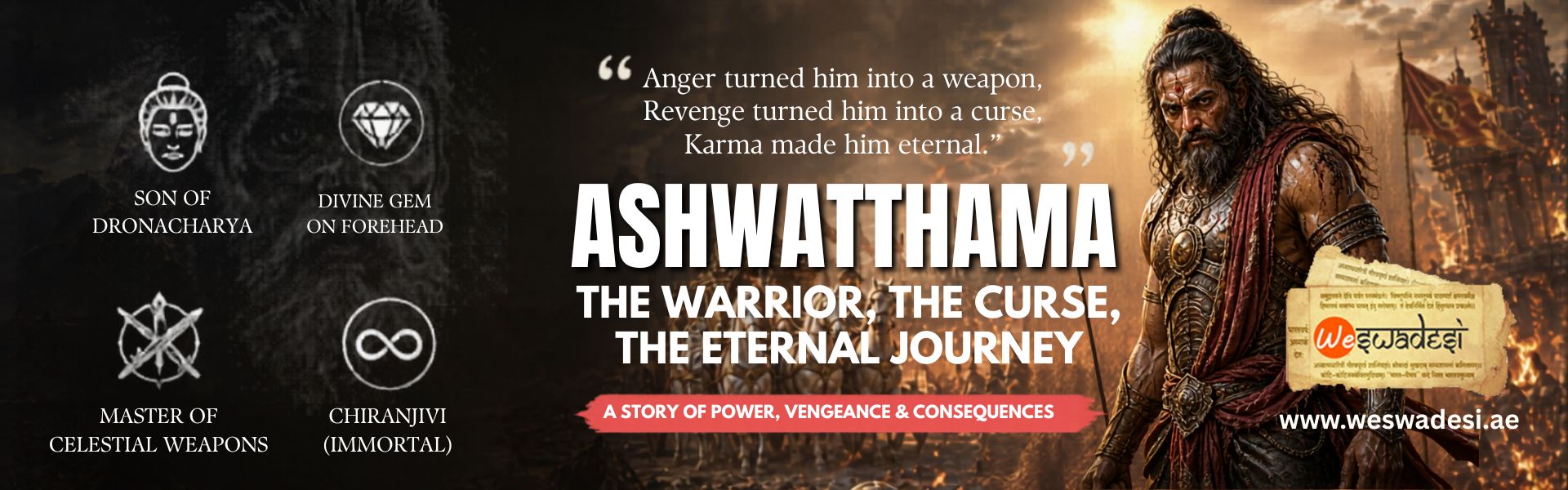
Among the most complex and thought-provoking characters of the Mahabharata, Ashwatthama stands as a powerful symbol of valor, vengeance, and the consequences of uncontrolled anger. Unlike many warriors who are remembered for their victories, Ashwatthama is remembered for his tragic fate—eternal life filled with suffering.
His story, deeply connected to the events surrounding the Bhagavad Gita, highlights the darker side of human nature and reinforces the importance of self-control, dharma, and righteous action.
Blessed with divine powers yet cursed to wander the earth forever, Ashwatthama’s journey is a profound lesson in karma and moral responsibility.
Key Facts About Ashwatthama
- Parents: Dronacharya and Kripi
- Allegiance: Kauravas
- Divine Gift: Gem (mani) on forehead granting invincibility
- Weapons: Brahmastra, Narayanastra
- Status: Chiranjivi (immortal being)
- Fate: Cursed by Krishna to wander eternally
Origins and Divine Birth
Ashwatthama was born to Drona, one of the greatest warriors and teachers in the Mahabharata. His birth was the result of intense penance performed by Drona to please Lord Shiva.
According to legend:
- Ashwatthama was born with a divine gem on his forehead
- His cry resembled a horse’s neigh, giving him his name
- He was destined to be a warrior of unmatched power
The gem (mani) granted him:
- Immunity from hunger and fatigue
- Protection from evil forces
- Near invincibility
This divine blessing made him one of the most feared warriors in the Kurukshetra war.
Training and Warrior Skills
Ashwatthama was trained alongside:
- Arjuna
- Duryodhana
- Other Kuru princes
Under the guidance of his father Drona, he mastered advanced warfare techniques and celestial weapons.
Master of Divine Weapons
Ashwatthama was one of the few warriors capable of using:
- Brahmastra – a powerful, destructive celestial weapon
- Narayanastra – a divine weapon invoking Lord Vishnu’s energy
His knowledge and power placed him among the most dangerous fighters in the war.
Role in the Mahabharata War
During the Kurukshetra war, Ashwatthama fought on the side of the Kauravas, led by Duryodhana.
He was:
- Loyal to his father and allies
- Fierce in battle
- Driven by honor and later, revenge
However, his story takes a tragic turn after the death of his father.
The Death of Dronacharya and Turning Point
The death of Dronacharya was a pivotal moment.
The Pandavas, unable to defeat Drona, used a strategic deception:
- They spread the news that Ashwatthama was dead
- Referring to an elephant named Ashwatthama
Believing his son was gone, Drona lost his will to fight and was killed.
Impact on Ashwatthama
This event shattered Ashwatthama emotionally.
He experienced:
- Deep grief
- Intense anger
- Desire for revenge
From this moment, his actions were no longer guided by dharma—but by vengeance.
The Night of Revenge
In one of the darkest episodes of the Mahabharata, Ashwatthama carried out a brutal night attack.
He:
- Entered the Pandava camp at night
- Attacked sleeping warriors
- Killed the sons of Draupadi
This act was considered:
- A violation of war ethics
- An act of extreme adharma
It marked the complete transformation of Ashwatthama—from warrior to avenger.
The Brahmastra Incident
In a final act of desperation, Ashwatthama released the Brahmastra against the unborn child of Uttara, aiming to destroy the Pandava lineage.
However:
- Krishna intervened
- He saved the unborn child, Parikshit
- Prevented total destruction
This act crossed all moral boundaries and led to severe consequences.
The Curse of Immortality
For his actions, Krishna cursed Ashwatthama.
The Curse
- He would live forever (Chiranjivi)
- His forehead wound would never heal
- He would wander the earth in pain and isolation
- He would be shunned by humanity
This curse transformed his divine blessing into eternal suffering.
Symbolism of Ashwatthama
Ashwatthama represents powerful philosophical themes:
1. Uncontrolled Anger
His rage led him to commit irreversible acts.
2. Misuse of Power
Despite divine gifts, he chose adharma.
3. Karma and Consequence
Every action has consequences—no matter how powerful you are.
4. Burden of Immortality
Eternal life without peace becomes a curse.
Connection to Bhagavad Gita
The teachings of the Bhagavad Gita emphasize:
- Control over emotions
- Righteous action
- Detachment from anger and ego
Ashwatthama represents the opposite path—what happens when these teachings are ignored.
While Krishna teaches Arjuna:
- To act with balance and wisdom
Ashwatthama shows:
- The destruction caused by impulsive action
Ashwatthama as a Chiranjivi
In Hindu tradition, Ashwatthama is one of the seven Chiranjivis—immortal beings who continue to live through ages.
He is believed to:
- Wander near the Narmada River
- Await the arrival of Kalki, the future avatar of Vishnu
- Carry the burden of his past actions
Cultural and Spiritual Legacy
Ashwatthama’s story continues to inspire:
In Religion
- Referenced in spiritual teachings
- Symbol of karma and justice
In Folklore
- Stories of sightings across India
- Belief in his eternal wandering
In Arts & Media
- Depicted in TV serials and books
- Reimagined in modern cinema
Ashwatthama in Modern Culture
Ashwatthama has gained renewed attention in modern storytelling.
One notable example is the film:
- Kalki 2898 AD
In this futuristic adaptation:
- Ashwatthama is portrayed as an immortal warrior
- Waiting for the arrival of Kalki
- Bridging mythology with science fiction
The character is portrayed by Amitabh Bachchan, bringing depth and gravitas to the role.
Life Lessons from Ashwatthama
1. Control Anger
Uncontrolled emotions can destroy everything.
2. Use Power Wisely
Strength without wisdom leads to downfall.
3. Follow Dharma
Right action is more important than revenge.
4. Think Before Acting
Impulsive decisions can have lifelong consequences.
5. Learn from Mistakes
His story is a warning for future generations.
Relevance in Modern Life
Ashwatthama’s story is highly relevant today.
In modern life:
- Anger and stress are common
- People often act impulsively
- Ethical boundaries are tested
His story teaches:
- Emotional control
- Responsibility
- Awareness of consequences
For Devotees in UAE
For those living abroad, Ashwatthama’s story serves as a reminder of:
- The importance of dharma
- Cultural values
- Spiritual discipline
Through platforms like weswadesi.ae, devotees can:
- Access spiritual books
- Learn about epics like Mahabharata
- Stay connected to Indian traditions
Conclusion
Ashwatthama is one of the most tragic and powerful figures in the Mahabharata. His life is a lesson in how divine blessings can turn into curses when guided by anger and revenge.
While heroes like Arjuna represent dharma, Ashwatthama reminds us of the consequences of straying from it.
His eternal journey stands as a warning:
- Power must be controlled
- Emotions must be balanced
- Dharma must always be followed
FAQs About Ashwatthama
1. Who is Ashwatthama?
Ashwatthama is the son of Dronacharya and a warrior in the Mahabharata, known for being immortal.
2. Why is Ashwatthama cursed?
He was cursed by Krishna for killing innocent people and attacking an unborn child.
3. Is Ashwatthama still alive?
According to belief, he is a Chiranjivi and continues to wander the earth.
4. What powers did Ashwatthama have?
He possessed a divine gem and mastery over celestial weapons like Brahmastra.
5. What does Ashwatthama symbolize?
He represents the consequences of anger, misuse of power, and karma.
