
- Your cart is empty
- Continue Shopping
Bhagavad Gita Chapter 2, Verse 22 – Meaning, Explanation & Life Lessons

Introduction
The Bhagavad Gita is one of the most profound spiritual texts in human history. Spoken by Lord Krishna to Arjuna on the battlefield of Kurukshetra, it addresses the deepest questions of life, death, duty, and the soul.
Among its many powerful teachings, Chapter 2, Verse 22 stands out as a simple yet deeply transformative explanation of life and death. This verse beautifully illustrates the concept of the immortality of the soul (Atman) and helps remove the fear of death by comparing the body to clothing.
Let’s explore this timeless shloka in depth.
The Shloka
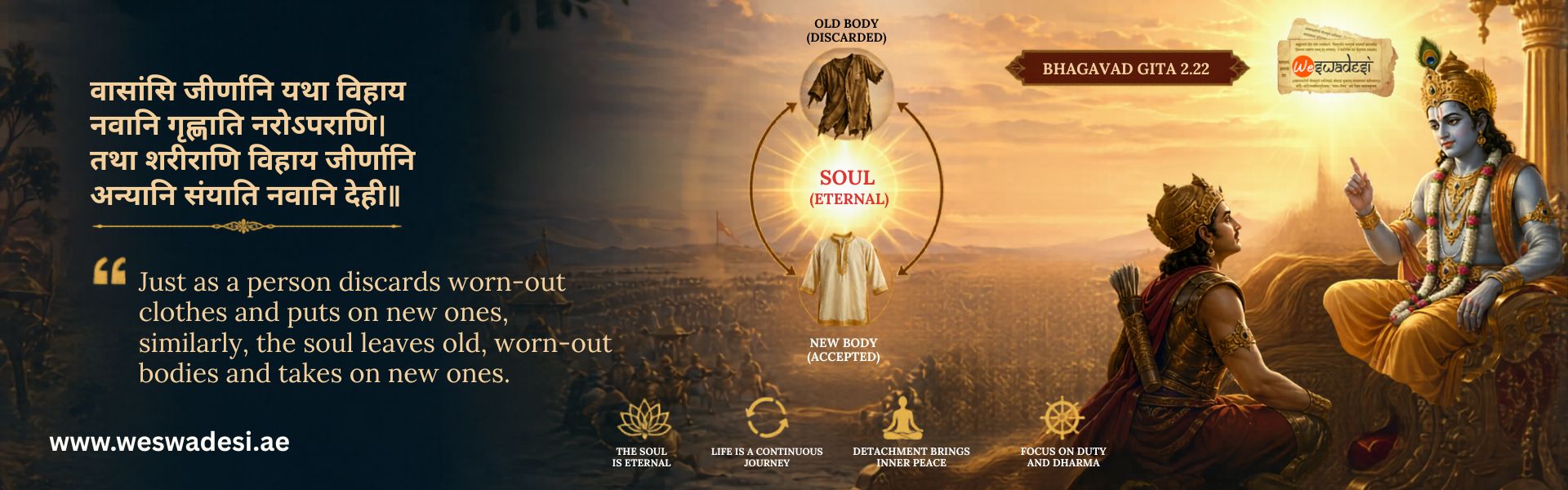
वासांसि जीर्णानि यथा विहाय
नवानि गृह्णाति नरोऽपराणि।
तथा शरीराणि विहाय जीर्णानि
अन्यानि संयाति नवानि देही॥
Transliteration
Vāsāṁsi jīrṇāni yathā vihāya
Navāni gṛhṇāti naro’parāṇi
Tathā śarīrāṇi vihāya jīrṇāni
Anyāni saṁyāti navāni dehī
Simple Meaning
Just as a person discards worn-out clothes and puts on new ones, similarly, the soul leaves old, worn-out bodies and takes on new ones.
सरल हिंदी में अर्थ:
जिस प्रकार मनुष्य पुराने और फटे हुए कपड़ों को छोड़कर नए कपड़े पहनता है, उसी प्रकार आत्मा पुराने और कमजोर शरीर को छोड़कर नया शरीर धारण करती है।
Word-by-Word Meaning
- वासांसि (Vāsāṁsi) – Clothes
- जीर्णानि (Jīrṇāni) – Worn-out, old
- विहाय (Vihāya) – Discarding
- नवानि (Navāni) – New
- गृह्णाति (Gṛhṇāti) – Accepts
- नरः (Naraḥ) – Person
- तथा (Tathā) – Similarly
- शरीराणि (Śarīrāṇi) – Bodies
- देही (Dehī) – The embodied soul
Context of the Verse in the Bhagavad Gita
This verse appears in Chapter 2, titled Sankhya Yoga. At this point, Arjuna is overwhelmed with sorrow and confusion about fighting in the war. Seeing his relatives and teachers on the battlefield, he refuses to fight.
Lord Krishna then begins to teach him the eternal truth of life—that the soul is immortal and cannot be destroyed.
This particular verse comes as part of a series where Krishna explains:
- The soul is eternal
- It is never born and never dies
- It cannot be cut, burned, or destroyed
Deep Philosophical Explanation
1. The Body is Temporary, The Soul is Eternal
This verse clearly separates the body and the soul.
The body:
- Is physical
- Changes with time
- Gets old and dies
The soul:
- Is eternal
- Never changes
- Never dies
Just like clothes are external and not part of our true identity, the body is also just a covering for the soul.
2. Death is Not the End
One of the biggest fears humans face is death. This verse removes that fear by redefining death:
- Death is not destruction
- It is simply a transition
- It is a change of “garment”
The soul continues its journey by taking a new body.
3. The Concept of Rebirth (Reincarnation)
This verse strongly supports the idea of reincarnation.
The soul:
- Leaves one body
- Enters another
- Continues its journey based on karma
This aligns with the broader teachings of Hindu philosophy and the law of karma.
4. Detachment from the Physical World
By understanding that the body is temporary, one naturally becomes less attached to:
- Physical appearance
- Material possessions
- Temporary relationships
This doesn’t mean neglecting life—but living with awareness and balance.
5. Acceptance of Change
Everything in life changes:
- Childhood → Youth → Old age
- Happiness → Sadness
- Gain → Loss
This verse teaches us to accept change as a natural part of existence.
Practical Life Lessons from This Shloka
1. Overcoming Fear of Death
Understanding this verse can bring peace during difficult times, especially when facing:
- Loss of loved ones
- Fear of mortality
It helps us realize that life continues beyond the physical body.
2. Handling Grief and Loss
When someone passes away, this teaching provides comfort:
- The person hasn’t “ended”
- They have simply moved on to another form
This perspective can ease emotional suffering.
3. Living with Purpose
If the soul continues its journey, then our actions (karma) matter deeply.
This encourages us to:
- Live ethically
- Perform our duties sincerely
- Grow spiritually
4. Reducing Material Attachment
Modern life often focuses heavily on material success. This verse reminds us:
- Wealth and possessions are temporary
- Inner growth is eternal
5. Building Inner Strength
When we understand the eternal nature of the soul, we become mentally stronger and less affected by external situations.
Scientific and Psychological Perspective
While the Bhagavad Gita is a spiritual text, its teachings also align with modern thought:
- Energy cannot be destroyed (Law of Conservation of Energy)
- Consciousness may exist beyond physical form (debated in science)
Psychologically, believing in continuity of existence can:
- Reduce anxiety about death
- Provide emotional stability
- Enhance resilience
Comparison with Other Gita Verses
This verse connects with other important teachings:
- Chapter 2, Verse 20 – The soul is never born or dies
- Chapter 2, Verse 23 – The soul cannot be destroyed by weapons
Together, these verses form a complete understanding of the eternal soul.
Modern-Day Relevance
Even in today’s fast-paced world, this verse remains highly relevant.
In Personal Life
- Helps deal with stress and uncertainty
- Encourages a balanced mindset
In Professional Life
- Reduces fear of failure
- Promotes long-term thinking
In Spiritual Growth
- Encourages self-realization
- Leads to inner peace
A Simple Analogy
Imagine you change your clothes every day. You don’t feel sad about leaving old clothes behind because:
- They are worn out
- They no longer serve you
Similarly, the soul leaves the body when it is no longer useful.
Key Takeaways
- The soul is eternal
- The body is temporary
- Death is a transition, not an end
- Life is a continuous journey
- Detachment leads to peace
Conclusion
Bhagavad Gita Chapter 2, Verse 22 offers a powerful and comforting perspective on life and death. By comparing the body to clothing, it simplifies one of the most complex spiritual truths.
The teaching encourages us to live with awareness, perform our duties, and focus on the eternal rather than the temporary.
When truly understood, this verse can transform fear into peace, confusion into clarity, and attachment into wisdom.
Frequently Asked Questions (FAQs)
1. What is the main message of Bhagavad Gita 2.22?
The main message is that the soul is eternal and changes bodies just like a person changes clothes.
2. Does this verse support reincarnation?
Yes, it clearly explains the concept of rebirth where the soul takes on new bodies.
3. Why is the body compared to clothes?
Because both are temporary coverings and not the true identity.
4. How can this verse help in dealing with death?
It helps us understand that death is not the end but a transition, reducing fear and grief.
5. Who is speaking this verse?
The verse is spoken by Lord Krishna to Arjuna.
6. What is meant by ‘Dehi’ in the verse?
‘Dehi’ refers to the soul or the one who resides in the body.
7. How is this verse relevant today?
It helps people manage stress, fear, and attachment in modern life.
8. Does science support this idea?
While not fully proven, some scientific principles like energy conservation align conceptually.
9. What lesson should we apply in daily life?
Focus on inner growth, perform duties, and avoid excessive attachment to temporary things.
10. Is this verse only for spiritual people?
No, its wisdom can benefit anyone seeking peace, clarity, and purpose in life.
