

- Your cart is empty
- Continue Shopping
Sanjaya: The Divine Narrator of Bhagavad Gita & Voice of Truth

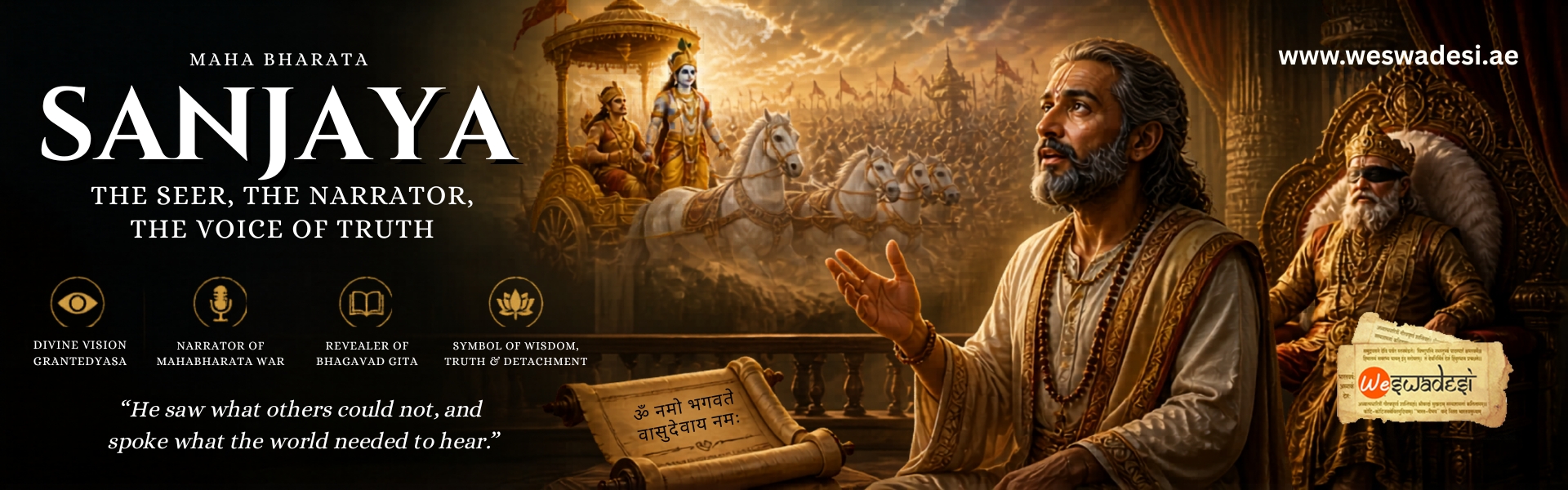
Introduction
In the vast and profound narrative of the Mahabharata, there are warriors, kings, and divine beings—but few characters possess the unique role of witnessing truth and conveying it with clarity. Sanjaya stands apart as the seer, narrator, and moral voice of the epic.
Blessed with divine vision by the sage Vyasa, Sanjaya was entrusted with the responsibility of narrating the events of the Kurukshetra War to the blind king Dhritarashtra. Through his narration, the timeless teachings of the Bhagavad Gita were revealed to the world.
Sanjaya is not just a storyteller—he is the embodiment of wisdom, neutrality, and spiritual insight.
Key Facts About Sanjaya
- Role: Charioteer and counselor to Dhritarashtra
- Divine Gift: Ability to see distant events (divine vision)
- Granted by: Sage Vyasa
- Significance: Narrator of Mahabharata war and Bhagavad Gita
- Symbolism: Inner vision, truth, and detachment
Sanjaya’s Role in the Mahabharata
Sanjaya plays a crucial role as the narrator of the Kurukshetra War.
Since King Dhritarashtra was blind and unable to witness the battlefield, Vyasa granted Sanjaya divine sight. This allowed him to:
- See events happening miles away
- Hear conversations between warriors
- Narrate the war in real time
Through Sanjaya’s narration, the king—and the audience—experienced the unfolding of one of the greatest epics in human history.
The Divine Vision: A Unique Blessing
The divine vision granted to Sanjaya was not merely physical—it was spiritual.
What Did This Vision Allow?
- To witness truth beyond distance
- To observe both action and intention
- To understand deeper meanings of events
This gift symbolizes:
- Awareness beyond senses
- Clarity beyond illusion
- Insight beyond emotion
In spiritual terms, Sanjaya represents the awakened consciousness that sees reality as it is.
Sanjaya and the Bhagavad Gita
One of Sanjaya’s most important contributions is his narration of the Bhagavad Gita.
When Arjuna hesitates on the battlefield and seeks guidance from Krishna, it is Sanjaya who narrates this divine conversation to Dhritarashtra.
Why This is Important
Without Sanjaya:
- The Bhagavad Gita would not have been recorded
- The teachings of Krishna might not have reached humanity
- The philosophical depth of the epic would be lost
Sanjaya acts as the medium through which divine wisdom flows to the world.
Sanjaya as a Counselor
Sanjaya was more than just a narrator—he was also a trusted advisor to Dhritarashtra.
His Role as a Counselor
- Advised the king to choose peace over war
- Warned against supporting Duryodhana
- Encouraged adherence to dharma
Despite being loyal to the king, Sanjaya remained committed to truth and righteousness.
Moral Courage and Integrity
Sanjaya’s greatest strength was his integrity.
He:
- Spoke truth even when it was uncomfortable
- Remained unbiased despite political pressure
- Did not manipulate facts for personal gain
In a court filled with ambition and ego, Sanjaya stood as a voice of reason.
Symbolism of Sanjaya
Sanjaya represents deep philosophical concepts:
1. Inner Vision
Seeing truth beyond physical perception.
2. Detachment
Remaining neutral despite emotional involvement.
3. Truthfulness
Commitment to honesty in all situations.
4. Awareness
Understanding both action and consequence.
Contrast with Dhritarashtra
Sanjaya’s character is often contrasted with Dhritarashtra.
| Sanjaya | Dhritarashtra |
|---|---|
| Has divine vision | Physically blind |
| Sees truth clearly | Blinded by attachment |
| Detached | Emotionally attached |
| Follows dharma | Compromises dharma |
This contrast teaches:
- Physical sight is less important than inner vision
- Attachment can blind even the wise
Spiritual Meaning in Bhagavad Gita Context
In the Bhagavad Gita framework:
- Arjuna represents the human mind
- Krishna represents divine guidance
- Sanjaya represents awareness or consciousness
Sanjaya’s narration reflects the ability to:
- Observe without attachment
- Understand without bias
- Accept truth without resistance
Lessons from Sanjaya
1. Speak the Truth
Even when it is difficult or unpopular.
2. Stay Neutral
Avoid bias in decision-making.
3. Develop Inner Awareness
Look beyond appearances.
4. Practice Detachment
Do your role without emotional attachment.
5. Be a Guide for Others
Help others see the truth clearly.
Relevance in Modern Life
In today’s world of information overload and bias, Sanjaya’s qualities are more relevant than ever.
We often face:
- Conflicting information
- Emotional decisions
- Ethical dilemmas
Sanjaya teaches us to:
- Stay calm and objective
- Analyze situations clearly
- Speak with honesty and wisdom
Sanjaya for Devotees in UAE
For Indians and Hindus living in the UAE, Sanjaya’s story offers valuable guidance:
- Stay connected to truth and values
- Practice spiritual awareness
- Read and understand the Bhagavad Gita
Platforms like weswadesi.ae support this journey by offering:
- Spiritual books
- Puja items
- Cultural resources
Cultural Impact of Sanjaya
Though not a warrior, Sanjaya holds a powerful place in cultural storytelling.
In Literature
- Narrator of Mahabharata
- Key voice in Bhagavad Gita
In Performances
- Depicted in plays and TV serials
- Portrayed as a wise and calm figure
In Philosophy
- Symbol of consciousness and awareness
Why Sanjaya Matters Today
Sanjaya’s relevance lies in his ability to:
- See clearly
- Speak honestly
- Guide wisely
In a world driven by noise and opinion, Sanjaya represents clarity and truth.
Conclusion
Sanjaya may not have fought in the Kurukshetra war, but his role was equally powerful. As the narrator of the Mahabharata and the Bhagavad Gita, he ensured that the wisdom of the ages reached humanity.
He reminds us that:
- Truth must be seen clearly
- Wisdom must be shared honestly
- Awareness is the highest form of knowledge
Sanjaya is not just a narrator—he is the voice of truth, the eye of wisdom, and the bridge between divine knowledge and human understanding.
FAQs About Sanjaya
1. Who is Sanjaya in the Mahabharata?
Sanjaya is the charioteer and counselor of King Dhritarashtra, known for narrating the Kurukshetra war.
2. How did Sanjaya get divine vision?
He received it from sage Vyasa, allowing him to see distant events.
3. What is Sanjaya’s role in the Bhagavad Gita?
He narrates the conversation between Krishna and Arjuna to Dhritarashtra.
4. What does Sanjaya symbolize?
He represents inner vision, truth, and spiritual awareness.
5. Why is Sanjaya important today?
He teaches us to stay truthful, objective, and aware in decision-making.
