
- Your cart is empty
- Continue Shopping
Bhagavad Gita Chapter 4, Verse 7 – Complete Explanation and Modern Relevance

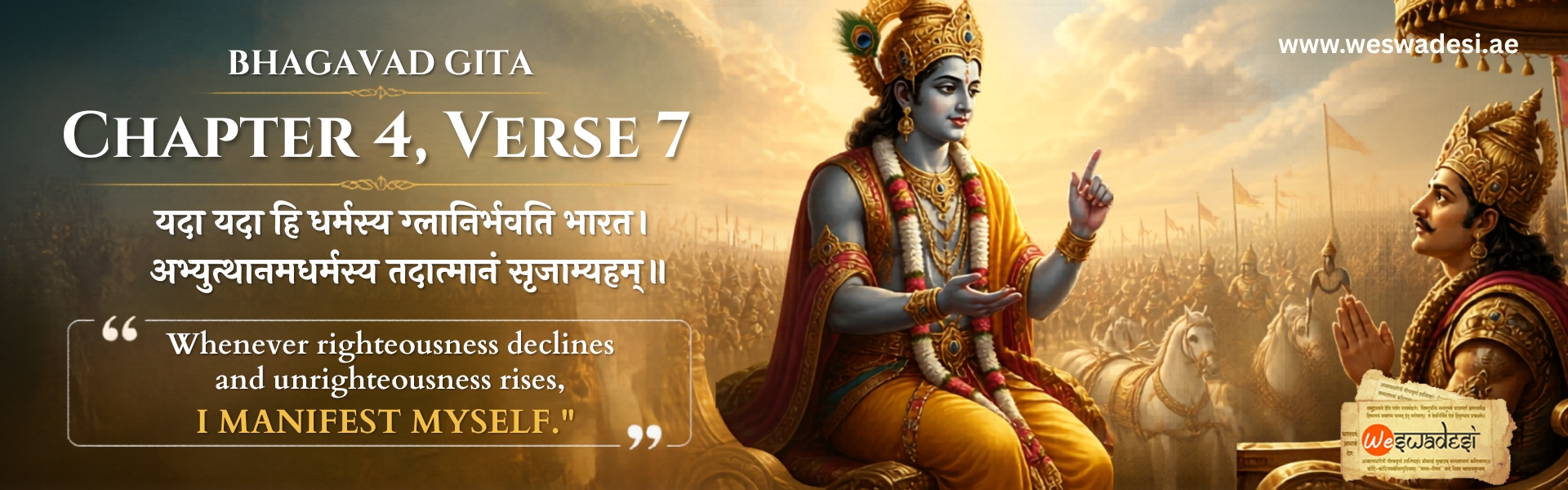
The Bhagavad Gita is one of the most profound spiritual texts ever composed. Among its 700 verses, Chapter 4, Verse 7 stands out as one of the most quoted and deeply impactful teachings. It explains the concept of divine intervention and reassures humanity that righteousness (Dharma) is never abandoned by the Divine.
The Verse
Sanskrit:
यदा यदा हि धर्मस्य ग्लानिर्भवति भारत।
अभ्युत्थानमधर्मस्य तदात्मानं सृजाम्यहम्॥
Transliteration:
Yadā yadā hi dharmasya glānir bhavati bhārata
Abhyutthānam adharmasya tadātmānaṁ sṛjāmyaham
Meaning:
Whenever righteousness declines and unrighteousness rises, I manifest myself.
Bhagavad Gita के अध्याय 4, श्लोक 7 में भगवान Lord Krishna बताते हैं कि जब-जब धर्म की हानि होती है और अधर्म बढ़ता है, तब वे स्वयं पृथ्वी पर प्रकट होते हैं। इसका अर्थ है कि जब समाज में अन्याय, अनैतिकता और असंतुलन बढ़ जाता है, तब ईश्वर किसी न किसी रूप में आकर धर्म की पुनः स्थापना करते हैं। यह श्लोक हमें विश्वास दिलाता है कि सत्य और धर्म हमेशा अंत में विजय प्राप्त करते हैं।
- जब धर्म कमजोर होता है, तब ईश्वर हस्तक्षेप करते हैं।
- अधर्म का बढ़ना समाज में असंतुलन और दुख का कारण बनता है।
- भगवान का प्रकट होना केवल अवतार के रूप में ही नहीं, बल्कि विभिन्न रूपों में हो सकता है।
- यह श्लोक हमें आशा और विश्वास देता है कि सत्य की जीत निश्चित है।
- हमें स्वयं भी धर्म का पालन करना चाहिए और सही मार्ग पर चलना चाहिए।
- ईश्वर हमेशा धर्म की रक्षा और अधर्म के नाश के लिए कार्य करते हैं।
- यह शिक्षा आज के समय में भी उतनी ही महत्वपूर्ण है जितनी प्राचीन काल में थी।
- हर व्यक्ति अपने कर्मों के माध्यम से धर्म की स्थापना में योगदान दे सकता है।
Understanding the Context of the Verse
This verse is spoken by Lord Krishna to Arjuna during the Kurukshetra war. At this moment, Arjuna is confused, emotionally overwhelmed, and morally conflicted about fighting his own relatives and teachers.
Krishna responds not just as a charioteer, but as the Supreme Being, revealing a universal truth: the Divine actively participates in maintaining cosmic balance.
Breaking Down the Verse Word by Word
To truly understand its depth, let’s break the verse into key components:
- Yadā Yadā (Whenever): Indicates that this is not a one-time event but a recurring divine principle.
- Dharmasya Glāniḥ (Decline of righteousness): Refers to moral, ethical, and spiritual decay in society.
- Adharmasya Abhyutthānam (Rise of unrighteousness): The growth of injustice, corruption, and ignorance.
- Sṛjāmi Aham (I manifest myself): The Divine takes form to restore balance.
This verse establishes that God is not passive—He intervenes when necessary.
What is Dharma?
To understand the verse, we must first understand Dharma.
Dharma is not just religion. It is:
- Moral duty
- Righteous conduct
- Universal law
- Ethical responsibility
- The natural order of life
Dharma governs both individual behavior and societal harmony. When Dharma is upheld, there is peace, justice, and balance. When it declines, chaos begins.
What is Adharma?
Adharma is the opposite of Dharma. It includes:
- Injustice
- Dishonesty
- Greed and exploitation
- Violence without cause
- Moral corruption
When Adharma increases, society begins to suffer. People lose trust, values erode, and suffering increases.
Why Does God Manifest?
According to this verse, God manifests for three main reasons:
1. To Restore Dharma
When moral values decline, divine intervention re-establishes righteousness.
2. To Protect the Good
Those who follow the path of truth and righteousness are protected.
3. To Eliminate Evil
Unrighteous forces are removed to restore balance.
This idea is further elaborated in the next verse (4.8), where Krishna says he appears to protect the righteous and destroy the wicked.
Forms of Divine Manifestation
The manifestation of God does not always mean a physical incarnation. It can take many forms:
1. Avatars (Incarnations)
In Hindu philosophy, God takes human or other forms, such as:
- Rama
- Krishna
- Narasimha
- Buddha
Each avatar appears in response to a specific crisis.
2. Through Great Leaders
Sometimes, divine will works through individuals who bring change—saints, reformers, and visionaries.
3. Through Inner Awakening
The divine can manifest within us as:
- Conscience
- Wisdom
- Courage
- Awareness
4. Through Natural Justice
Sometimes, balance is restored through natural consequences of actions (karma).
Philosophical Significance of the Verse
This verse is not just about divine intervention—it is about cosmic law.
1. The Universe is Self-Correcting
Whenever imbalance occurs, corrective forces emerge.
2. God is Actively Involved
The Divine is not distant or indifferent. It participates in the world.
3. Dharma is Eternal
Even if it declines temporarily, it can never be destroyed permanently.
4. Hope for Humanity
This verse offers reassurance: no matter how dark times become, righteousness will prevail.
Modern-Day Relevance of Bhagavad Gita 4.7
Even in today’s world, this verse remains highly relevant.
1. Social and Moral Decline
We often see:
- Corruption
- Inequality
- Environmental destruction
- Ethical compromises
These are signs of declining Dharma.
2. Rise of Adharma
Unethical practices are sometimes normalized, making it harder to distinguish right from wrong.
3. Need for Change
This verse reminds us that change is inevitable—and necessary.
Is God Still Manifesting Today?
A common question is: does God still manifest today?
The answer depends on interpretation.
Spiritual Perspective
God manifests in subtle ways:
- Through wisdom teachings
- Through inner guidance
- Through collective awakening
Practical Perspective
Divine intervention can be seen in:
- Movements for justice
- Social reforms
- Acts of courage and truth
The message is clear: Divine presence is always active, even if not always visible.
Your Role in Upholding Dharma
This verse is not just about God—it is also about us.
Krishna’s message implies:
- Don’t wait for divine intervention
- Become an instrument of Dharma
- Act with righteousness in daily life
Ways to Practice Dharma Today
- Be honest in your work
- Help others without selfish motives
- Stand against injustice
- Follow ethical principles
- Maintain self-discipline
When individuals follow Dharma, society naturally improves.
Spiritual Interpretation: Inner Battlefield
Just like Arjuna faced a battlefield, we face our own inner conflicts:
- Right vs Wrong
- Ego vs Wisdom
- Fear vs Courage
When Adharma rises within us (anger, greed, ignorance), Krishna manifests as inner awareness to guide us.
Lessons from This Verse
1. Change is Inevitable
Whenever imbalance occurs, correction follows.
2. Righteousness Always Wins
Even if delayed, truth ultimately prevails.
3. Divine Support is Constant
You are never alone in your struggle for truth.
4. Take Responsibility
Be a contributor to Dharma, not just a spectator.
Connection with Karma and Duty
This verse connects strongly with Karma Yoga (the path of action).
Krishna encourages:
- Perform your duty
- Stay aligned with Dharma
- Do not fear outcomes
When people abandon their duties, Dharma declines.
Why This Verse is So Popular
This verse is widely quoted because:
- It offers hope during difficult times
- It explains divine justice
- It reassures moral order
- It applies to all generations
It is a timeless reminder that goodness is never abandoned by the universe.
Conclusion
Bhagavad Gita Chapter 4, Verse 7 is not just a spiritual statement—it is a universal law of balance. It teaches us that whenever chaos rises, order will follow. Whenever darkness spreads, light will emerge.
The real message is not just that God will come—but that we must also rise to uphold Dharma.
By living ethically, acting responsibly, and staying aligned with truth, we become part of the divine mission.
Frequently Asked Questions (FAQs)
1. What is the main message of Bhagavad Gita 4.7?
It teaches that God manifests whenever righteousness declines and unrighteousness rises to restore balance.
2. What does “manifestation of God” mean?
It can mean physical incarnations, spiritual guidance, or divine influence through people and events.
3. Does God take human form every time Dharma declines?
Not necessarily. Manifestation can be symbolic, spiritual, or through individuals.
4. What is Dharma in simple terms?
Dharma means righteousness, duty, moral values, and living in harmony with truth.
5. How can we apply this verse in daily life?
By practicing honesty, fairness, compassion, and fulfilling our responsibilities.
6. Is this verse relevant in modern times?
Yes, it is highly relevant as it explains moral decline and the need for ethical living.
7. What is Adharma?
Adharma is injustice, immorality, and actions that go against truth and righteousness.
8. Can humans act as instruments of divine will?
Yes, by following Dharma, individuals can become agents of positive change.
9. How does this verse relate to Karma?
It emphasizes doing the right action and fulfilling duties to maintain balance.
10. Why is this verse important in Hindu philosophy?
It explains divine intervention, cosmic balance, and the eternal victory of righteousness.
